Two coherent plane electromagnetic waves of wavelength $0.5 \ \mu\text{m}$ (both have the same amplitude and are linearly polarized along the $z$-direction) fall on the $y = 0$ plane. Their wave vectors $\mathbf{k}_1$ and $\mathbf{k}_2$ are as shown in the figure. If the angle $\theta$ is $30^\circ$, the fringe spacing of the interference pattern produced on the plane is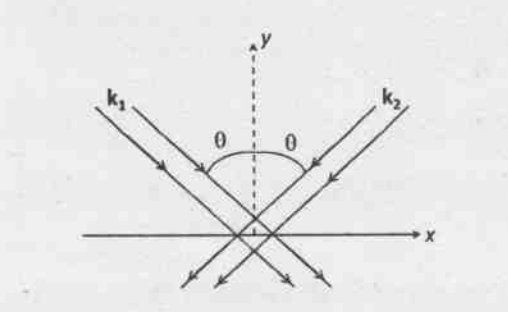
Let's solve the problem step-by-step to find the fringe spacing of the interference pattern produced by the two coherent plane electromagnetic waves.
Given:
- Wavelength of the waves, \(\lambda = 0.5 \ \mu\text{m}\).
- Angle between each wave vector and the normal to the plane, \(\theta = 30^\circ\).
The fringe spacing \(d\) in the interference pattern can be calculated using the formula:
\(d = \frac{\lambda}{2 \sin\theta}\)
Substituting the given values:
\(d = \frac{0.5 \ \mu\text{m}}{2 \sin 30^\circ}\)
Since \(\sin 30^\circ = 0.5\), we have:
\(d = \frac{0.5 \ \mu\text{m}}{2 \times 0.5} = \frac{0.5 \ \mu\text{m}}{1} = 0.5 \ \mu\text{m}\)
Therefore, the fringe spacing is \(0.5 \ \mu\text{m}\).
Thus, the correct answer is:
- \(0.5 \ \mu\text{m}\)
Important Questions from Optics and Diffraction
The diameters of the pinholes of two otherwise identical cameras $A$ and $B$ are $500$ $\mu \text{m}$ and $200 \text{ } \mu \text{m}$, respectively. Then the image in camera $A$ will be
A monochromatic and linearly polarised light is used in a Young's double slit experiment. A linear polarizer, whose pass axis is at an angle $45^\circ$ to the polarization of the incident wave, is placed in front of one of the slits. If $I_{max}$ and $I_{min}$, respectively, denote the maximum and minimum intensities of the interference pattern on the screen, the visibility, defined as the ratio $\frac{I_{max} - I_{min}}{I_{max} + I_{min}}$ is
- The separation between the energy levels of a two-level atom is 2 eV. Suppose that $4 \times 10^{20}$ atoms are in the ground state and $7 \times 10^{20}$ atoms are pumped into the excited state just before lasing starts. How much energy will be released in a single laser pulse?
The figure below describes the arrangement of slits and screens in a Young's double slit experiment. The width of the slit in $\text{S}_1$ is $a$ and the slits in $\text{S}_2$ are of negligible width.
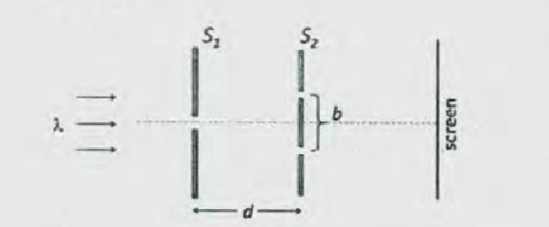
If the wavelength of the light is $\lambda$, the value of $d$ for which the screen would be dark isThe following configuration of three identical narrow slits are illuminated by monochromatic light of wavelength $\lambda$ (as shown in the figure below). The intensity is measured at an angle $\theta$ (where $\theta$ is the angle with the incident beam) at a large distance from the slits. If $\delta = \frac{2\pi d}{\lambda} \sin\theta$, the intensity is proportional to