
The diameters of the pinholes of two otherwise identical cameras $A$ and $B$ are $500$ $\mu \text{m}$ and $200 \text{ } \mu \text{m}$, respectively. Then the image in camera $A$ will be
Pinhole Size and Image Sharpness
The sharpness of an image formed by a pinhole camera depends on the pinhole size. A smaller pinhole reduces the spread of light rays, leading to a sharper image. Conversely, a larger pinhole allows more light rays but also increases diffraction effects and the blurring of the image.
- Camera A Pinhole Diameter: $D_A = 500 \text{ } \mu \text{m}$
- Camera B Pinhole Diameter: $D_B = 200 \text{ } \mu \text{m}$
Since $D_A > D_B$, Camera A has a larger pinhole, resulting in an image that is less sharp than the image in Camera B.
Pinhole Size and Image Brightness
The brightness of the image is determined by the amount of light that passes through the pinhole. The amount of light is proportional to the area of the pinhole.
The area of a circular pinhole is given by $A = \pi r^2 = \pi (D/2)^2$, which is proportional to the square of the diameter ($D^2$).
- Area of Camera A's pinhole: $A_A \propto D_A^2 = (500 \text{ } \mu \text{m})^2 = 250000 \text{ } \mu \text{m}^2$
- Area of Camera B's pinhole: $A_B \propto D_B^2 = (200 \text{ } \mu \text{m})^2 = 40000 \text{ } \mu \text{m}^2$
Since $A_A > A_B$, Camera A allows more light to enter than Camera B. Therefore, the image in Camera A will be brighter than the image in Camera B.
Conclusion
Combining the effects on sharpness and brightness:
- Camera A (larger pinhole) produces a less sharp image.
- Camera A (larger pinhole) produces a brighter image.
Thus, the image in camera A will be less sharp and brighter than in B.
Important Questions from Optics and Diffraction
A monochromatic and linearly polarised light is used in a Young's double slit experiment. A linear polarizer, whose pass axis is at an angle $45^\circ$ to the polarization of the incident wave, is placed in front of one of the slits. If $I_{max}$ and $I_{min}$, respectively, denote the maximum and minimum intensities of the interference pattern on the screen, the visibility, defined as the ratio $\frac{I_{max} - I_{min}}{I_{max} + I_{min}}$ is
- The separation between the energy levels of a two-level atom is 2 eV. Suppose that $4 \times 10^{20}$ atoms are in the ground state and $7 \times 10^{20}$ atoms are pumped into the excited state just before lasing starts. How much energy will be released in a single laser pulse?
The figure below describes the arrangement of slits and screens in a Young's double slit experiment. The width of the slit in $\text{S}_1$ is $a$ and the slits in $\text{S}_2$ are of negligible width.
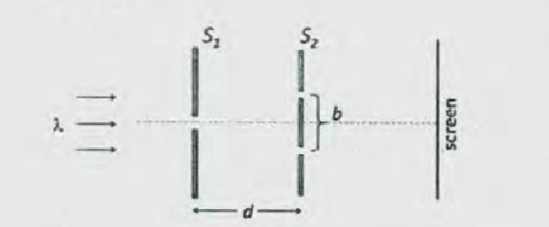
If the wavelength of the light is $\lambda$, the value of $d$ for which the screen would be dark isA screen has two slits, each of width $w$, with their centres at a distance $2w$ apart. It is illuminated by a monochromatic plane wave travelling along the $x$-axis.
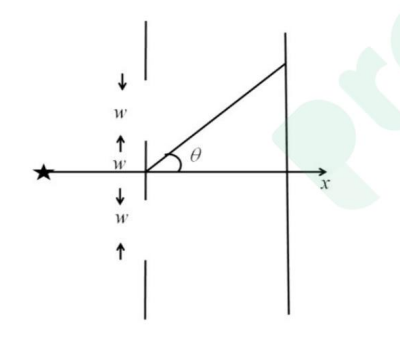
The intensity of the interference pattern, measured on a distant screen, at an angle $\theta = n\lambda/w$ to the $x$-axis isA film projector and microscope give equal magnification. But a film projector is not used to see living cells because


