
Laser Energy Release Calculation
This solution details the calculation for the energy released during a single laser pulse in a two-level atomic system.
Given Parameters
- Energy separation between levels: $\Delta E = 2$ eV
- Number of atoms in ground state: $N_g = 4 \times 10^{20}$
- Number of atoms in excited state: $N_e = 7 \times 10^{20}$
Energy Release Calculation
The total energy released ($E$) is determined by the number of atoms transitioning and the energy difference ($\Delta E$) per atom. The calculation uses the following formula:
$ E = \frac{N_e - N_g}{2} \times \Delta E $
This formula considers half the population inversion multiplied by the energy separation.
Step-by-Step Calculation
- Determine the population inversion: $N_{inv} = N_e - N_g = 7 \times 10^{20} - 4 \times 10^{20} = 3 \times 10^{20}$ atoms.
- Calculate the effective number of atoms contributing to energy release: $N_{eff} = \frac{N_{inv}}{2} = \frac{3 \times 10^{20}}{2} = 1.5 \times 10^{20}$ atoms.
- Calculate the total energy released in electron volts (eV): $E_{eV} = N_{eff} \times \Delta E = (1.5 \times 10^{20} \text{ atoms}) \times (2 \text{ eV/atom}) = 3 \times 10^{20}$ eV.
- Convert the total energy from eV to Joules (J). Use the conversion factor $1 \text{ eV} = 1.602 \times 10^{-19}$ J: $E_J = (3 \times 10^{20}) \times (1.602 \times 10^{-19})$ J $E_J = 4.806 \times 10^1$ J $E_J = 48.06$ J.
Final Result
The calculated energy release is approximately 48.06 J. This value rounds to 48 J.
Important Questions from Optics and Diffraction
The diameters of the pinholes of two otherwise identical cameras $A$ and $B$ are $500$ $\mu \text{m}$ and $200 \text{ } \mu \text{m}$, respectively. Then the image in camera $A$ will be
A monochromatic and linearly polarised light is used in a Young's double slit experiment. A linear polarizer, whose pass axis is at an angle $45^\circ$ to the polarization of the incident wave, is placed in front of one of the slits. If $I_{max}$ and $I_{min}$, respectively, denote the maximum and minimum intensities of the interference pattern on the screen, the visibility, defined as the ratio $\frac{I_{max} - I_{min}}{I_{max} + I_{min}}$ is
The figure below describes the arrangement of slits and screens in a Young's double slit experiment. The width of the slit in $\text{S}_1$ is $a$ and the slits in $\text{S}_2$ are of negligible width.
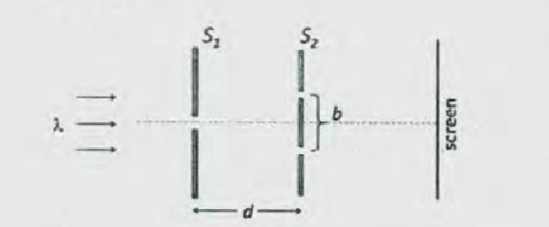
If the wavelength of the light is $\lambda$, the value of $d$ for which the screen would be dark isA screen has two slits, each of width $w$, with their centres at a distance $2w$ apart. It is illuminated by a monochromatic plane wave travelling along the $x$-axis.
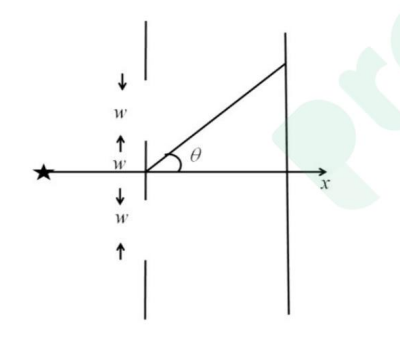
The intensity of the interference pattern, measured on a distant screen, at an angle $\theta = n\lambda/w$ to the $x$-axis isA film projector and microscope give equal magnification. But a film projector is not used to see living cells because


