
The figure below describes the arrangement of slits and screens in a Young's double slit experiment. The width of the slit in $\text{S}_1$ is $a$ and the slits in $\text{S}_2$ are of negligible width.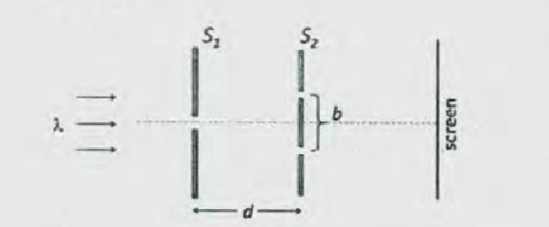
If the wavelength of the light is $\lambda$, the value of $d$ for which the screen would be dark is
In Young's double slit experiment, for a dark fringe to occur on the screen, the path difference between the light beams coming from the two slits must be an odd multiple of half the wavelength. This can be mathematically represented as:
\(d \sin \theta = (2m + 1)\frac{\lambda}{2}\)
where \(m\) is an integer (0, 1, 2, ...), \(d\) is the distance between the two slits, and \(\theta\) is the angle of diffraction.
Given that the width of the slit at \(\text{S}_1\) is \(a\) and the slits at \(\text{S}_2\) are of negligible width, we want the condition under which the central fringe is dark.
For central maxima to become dark due to \(\text{S}_2\):
The central maximum is generally formed at zero path difference. Therefore, for central dark fringe due to interference between \(\text{S}_1\) and \(\text{S}_2\), the path difference should be due to the shifted phase provided by the slits at \(\text{S}_2\) and should be zero.
Using the energy conservation and symmetry, we note that the position leading to this condition is dictated by the geometry setup of the configuration, where alignment of nodes and antinodes lead to a condition sometimes derived as:
\(d = \frac{b}{2} \sqrt{\left(\frac{a}{\lambda}\right)^2 - 1}\)
This expresses the condition, removing any physical path differences and focusing on amplitude or intensity overlap.
Therefore, the correct value of \(d\) for which the screen would be dark is:
\(\frac{b}{2} \sqrt{\left(\frac{a}{\lambda}\right)^2 - 1}\)
Important Questions from Optics and Diffraction
The diameters of the pinholes of two otherwise identical cameras $A$ and $B$ are $500$ $\mu \text{m}$ and $200 \text{ } \mu \text{m}$, respectively. Then the image in camera $A$ will be
A monochromatic and linearly polarised light is used in a Young's double slit experiment. A linear polarizer, whose pass axis is at an angle $45^\circ$ to the polarization of the incident wave, is placed in front of one of the slits. If $I_{max}$ and $I_{min}$, respectively, denote the maximum and minimum intensities of the interference pattern on the screen, the visibility, defined as the ratio $\frac{I_{max} - I_{min}}{I_{max} + I_{min}}$ is
- The separation between the energy levels of a two-level atom is 2 eV. Suppose that $4 \times 10^{20}$ atoms are in the ground state and $7 \times 10^{20}$ atoms are pumped into the excited state just before lasing starts. How much energy will be released in a single laser pulse?
A screen has two slits, each of width $w$, with their centres at a distance $2w$ apart. It is illuminated by a monochromatic plane wave travelling along the $x$-axis.
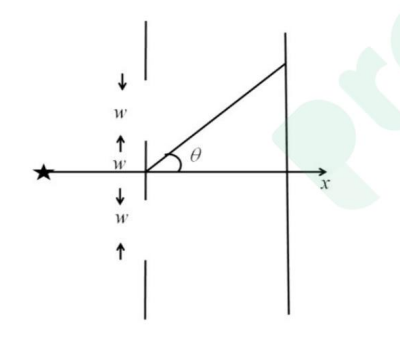
The intensity of the interference pattern, measured on a distant screen, at an angle $\theta = n\lambda/w$ to the $x$-axis isA film projector and microscope give equal magnification. But a film projector is not used to see living cells because


