
The following configuration of three identical narrow slits are illuminated by monochromatic light of wavelength $\lambda$ (as shown in the figure below). The intensity is measured at an angle $\theta$ (where $\theta$ is the angle with the incident beam) at a large distance from the slits. If $\delta = \frac{2\pi d}{\lambda} \sin\theta$, the intensity is proportional to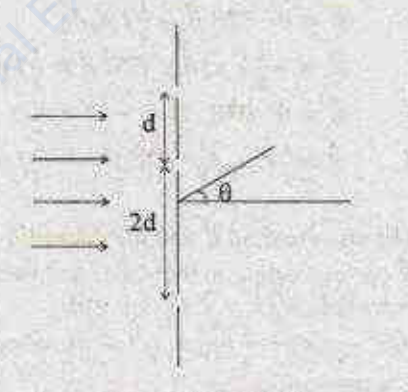
The problem involves interference from three identical narrow slits illuminated by monochromatic light. The goal is to find the expression for the intensity at an angle \(\theta\) where \(\delta = \frac{2\pi d}{\lambda} \sin\theta\).
Given that there are three slits, the standard expression for the intensity due to multiple slits is:
\(I(\theta) \propto E_0^2 [1 + 2\cos(\delta) + 2\cos(2\delta) + 2\cos(3\delta)]\)
Here, \(E_0\) is the amplitude of the light wave, and the intensity at the angle \(\theta\) depends on the phase difference between waves from different slits.
We know that light coming from different slits will interfere constructively or destructively depending on the path difference. The phase difference \(\delta\) is related to this path difference. For multiple slits:
- The intensity is affected by interference terms like \(2\cos(\delta)\), \(2\cos(2\delta)\), and \(2\cos(3\delta)\).
- The main maxima or minima occur depending on integer multiples of these phase differences.
The correct expression from the options is: \(3 + 2\cos(\delta) + 2\cos(2\delta) + 2\cos(3\delta)\).
This option correctly represents the pattern of interference produced by the three slits because it includes the terms accounting for the additional constructive/destructive interference contributions at \(\delta\), \(2\delta\), and \(3\delta\).
Important Questions from Optics and Diffraction
The diameters of the pinholes of two otherwise identical cameras $A$ and $B$ are $500$ $\mu \text{m}$ and $200 \text{ } \mu \text{m}$, respectively. Then the image in camera $A$ will be
A monochromatic and linearly polarised light is used in a Young's double slit experiment. A linear polarizer, whose pass axis is at an angle $45^\circ$ to the polarization of the incident wave, is placed in front of one of the slits. If $I_{max}$ and $I_{min}$, respectively, denote the maximum and minimum intensities of the interference pattern on the screen, the visibility, defined as the ratio $\frac{I_{max} - I_{min}}{I_{max} + I_{min}}$ is
- The separation between the energy levels of a two-level atom is 2 eV. Suppose that $4 \times 10^{20}$ atoms are in the ground state and $7 \times 10^{20}$ atoms are pumped into the excited state just before lasing starts. How much energy will be released in a single laser pulse?
The figure below describes the arrangement of slits and screens in a Young's double slit experiment. The width of the slit in $\text{S}_1$ is $a$ and the slits in $\text{S}_2$ are of negligible width.
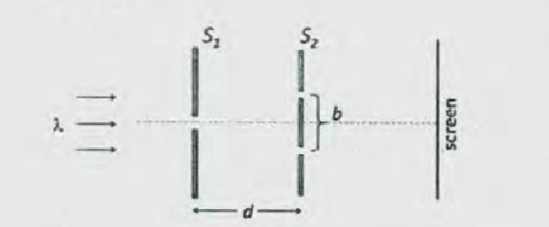
If the wavelength of the light is $\lambda$, the value of $d$ for which the screen would be dark isTwo coherent plane electromagnetic waves of wavelength $0.5 \ \mu\text{m}$ (both have the same amplitude and are linearly polarized along the $z$-direction) fall on the $y = 0$ plane. Their wave vectors $\mathbf{k}_1$ and $\mathbf{k}_2$ are as shown in the figure.
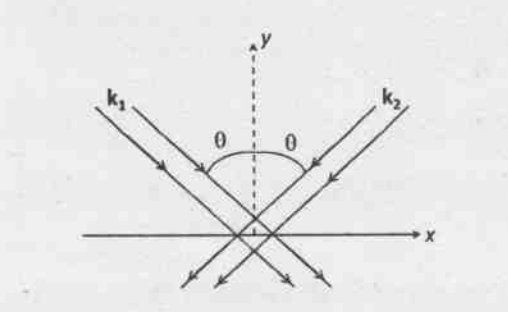
If the angle $\theta$ is $30^\circ$, the fringe spacing of the interference pattern produced on the plane is


