
Two circles with radii r₁ and r₂ touch each other externally. If the length of their direct common tangent is T, which of the following is the correct relationship between T, r₁ and r₂?
\(T = 2\sqrt{r_1 r_2}\)
Step 1 – Distance between centres for externally touching circles:
\(d = r_1 + r_2\)
Step 2 – Standard formula for the length of the direct common tangent:
\(T = \sqrt{d^2 - (r_1 - r_2)^2}\)
Step 3 – Substitute d = r₁ + r₂ and expand:
\(T^2 = (r_1 + r_2)^2 - (r_1 - r_2)^2 = 4 r_1 r_2\)
\(T = 2\sqrt{r_1 r_2}\)
Hence the answer is option 3.
Similar Questions
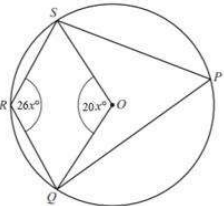
In the figure shown above, quadrilateral PQRS has its vertices on the circumference of the circle with center O. If ∠QOS = 20x° and ∠QRS = 26x°, then what is the value of ‘x’?
For two circles of radius 7 units and 7½ units, whose centres are 15 units apart, what is the length of the direct common tangent in units? (Correct to 3 decimal places.)
A right triangle ABC is inscribed in a circle with a diameter of 10 cm. An altitude BD is drawn from the vertex B to the hypotenuse AC. If the length of the leg AB is 6 cm, what is the length of the segment AD?
AB is the chord of the circle with center O. A line segment DOC originating from a point D on the circumference of the circle in major segment meets AB produced at C such that BC = OD. If angle BCO = 30°, then angle AOD is:
Three non-overlapping, non-touching circles are drawn in a plane. What is the maximum number of distinct common tangents that can be drawn to them in total?
From a point P outside a circle, a tangent PA and a secant PBC are drawn. If PA = 6 cm and BC = 5 cm, what is the length of the segment PB?
A triangle ABC is inscribed in a circle. A tangent is drawn to the circle at point A, intersecting the extension of side BC at D. If AD = 6 cm and CD = 4 cm, what is the length of side BC?
A circle is inscribed in a right triangle with legs of length 5 and 12. What is the radius of the circle?
A chord of a circle has a length of 12 cm. The angle subtended by the chord at a point on the circumference is 30°. What is the distance from the center of the circle to the chord?
What is the area of the segment formed by a chord in a circle of radius 8 cm, if the angle subtended at the center is 60°?
Important Questions from Circles, Chords and Tangents
- A circular coin of radius 1 cm is allowed to roll freely on the periphery over a circular disc of radius 10 cm. If the disc has no movement and the coin completes one revolution rolling on the periphery over the disc and without slipping, then what is the number of times the coin rotated about its centre ?
There are two concentric circles. The radii of the two circles are 100 m and 110 m respectively. A wheel of radius 30 cm rolls on the smaller circle and another wheel rolls on the larger circle. After they have completed one revolution, it is found that the two wheels rolled equal number of times
on their respective axes. What is the radius of the other wheel ?- The length of a tangent drawn to a circle of radius 4 cm from a point 5 cm away from the center of the circle is:
- If SA and SB are tangents to a circle from an outside point S, such that SA = 12 cm and angle ASB = 60°. What will the length of chord AB be?
- In a circle, two chords of lengths x and y subtend the angles of $60^{\circ}$ and $90^{\circ}$ at the center respectively. Which of the following is correct in this scenario?



