
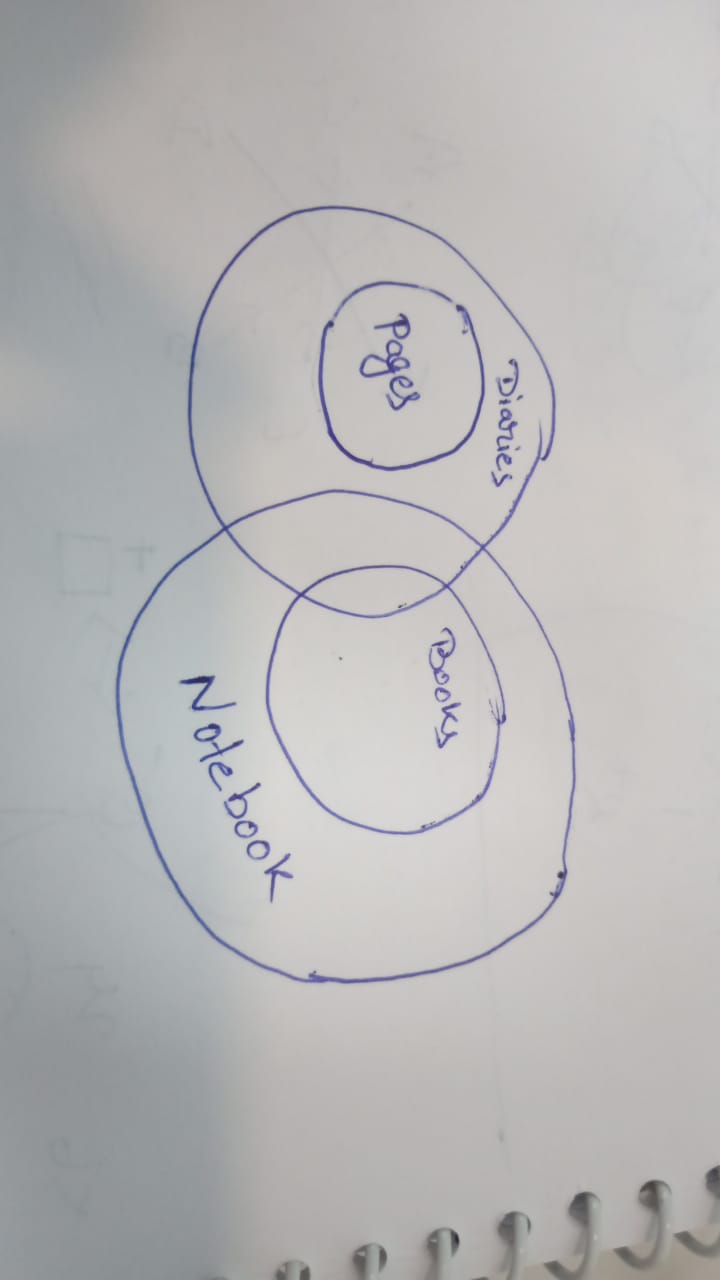
Three statements are given, followed by three conclusions numbered I, II and III. Assuming the statements to be true, even if they seem to be at variance with commonly known facts, decide which of the conclusions logically follow(s) from the statements. Statements: All pages are diaries. Conclusions: I. No page is a notebook.
Some diaries are books.
All books are notebooks.
II. All pages are notebooks.
III. All diaries being notebooks is a possibility.
Only conclusion III follows
Conclusion III logically follows because it is possible for all diaries to be notebooks based on the given statements. Conclusions I and II contradict the given facts.
Similar Questions
Consider the given statement/s to be true and decide which of the given conclusions/assumptions can definitely be drawn from the given statement. Statement: Irregularity is a cause for failure in exams. Some regular students fail in the examinations. Conclusions: I. All failed students are regular. II. All successful students are not regular.
Read the following statement carefully and identify the conclusion that follows.
Statement: Smoking is prohibited in public places as per the new law.
Conclusions:
I. People can smoke in private spaces.
II. Smoking harms public health.
Read the following statement carefully and identify the conclusion that follows.
Statement: Fewer people applied for teaching posts this year.
Conclusions:
I. Teaching is losing popularity.
II. Applicants may be seeking better-paying jobs.
Read the following statement carefully and identify the conclusion that follows.
Statement: The government has increased import duty on luxury cars.
Conclusions:
I. Imported luxury cars will become more expensive.
II. Local car manufacturers will stop making budget cars.Read the following statement carefully and identify the conclusion that follows.
Statement: Attendance in public libraries has increased in recent years.
Conclusions:
I. People are regaining interest in reading.
II. Digital platforms have become less popular.A statement is followed by two arguments I and II. Read the statement and the arguments carefully and select the appropriate answer from the given options.
Statement: Hydroelectricity is a cleaner and greener energy than other forms of power generation.
Arguments:
(I) Hydroelectric plants almost have nil CO2 emissions.
(II) Hydroelectric power projects submerge huge amounts under water thereby affecting local flora and fauna.
Read the following statement carefully and identify the conclusion that follows.
Statement: The bank has introduced a biometric login system.
Conclusions:
I. The bank wants to improve security.
II. Customers must carry biometric IDs.
Read the following statement carefully and identify the conclusion that follows.
Statement: The economy grew by 8% this year, the highest in a decade.
Conclusions:
I. Economic reforms have been successful.
II. Growth in previous years was below 8%.
Read the following statement carefully and identify the conclusion that follows.
Statement: The government has announced a reduction in LPG subsidies.
Conclusions:
I. Citizens will now have to pay more for LPG.
II. The government has no money left.
Read the following statement carefully and identify the conclusion that follows.
Statement: Traffic violations have decreased after the installation of speed cameras.
Conclusions:
I. Surveillance discourages rule-breaking.
II. People respect traffic rules voluntarily.
Important Questions from Statement and Conclusions
two Statements are given followed by two Conclusions:
Statements: All numbers are divisible by 2. All numbers are divisible by 3.
Conclusion-I All numbers are divisible by 6.
Conclusion-Il All numbers are divisible by 4.
Which of the above Conclusions logically follows/follow from the two given Statements?
Two Statements are given followed by two Conclusions:
Statements: All cats are dogs. All cats are black.
Conclusion-I: All dogs are black.
Conclusion-II: Some dogs are not black.
Which of the above Conclusions logically follows/follow from the two given Statements disregarding commonly known facts?
Directions for the following 2 (two) items: Read the following statements SI and S2 and answer the two items that follow:
S1: Twice the weight of Sohan is less than the weight of Mohan or that of Rohan.
S2: Twice the weight of Rohan is greater than the weight of Mohan or that of Sohan.
Which one of the following statements is correct?
Read the following statements SI and S2 and answer the two items that follow: S1: Twice the weight of Sohan is less than the weight of Mohan or that of Rohan. S2: Twice the weight of Rohan is greater than the weight of Mohan or that of Sohan.
Which one of the following statements is correct?
Directions for the following 7 (seven) items: Read the following five passages and answer the items that follow each passage. Your answers to these items should be based on the passages only.
Passage - 1 India's economic footprint, given its population, still remains small compared to the US, the European Union or China. It has much to learn from other economies, yet must implement solutions that fit its unique circumstances. India especially needs an effective long-term regulatory system based on collaboration rather than the ' current top-down approach. Regulations seek desirable outcomes yet are repeatedly used as political tools to push one agenda or another. Often, regulations fail to consider impacts on jobs and economic growth — or less restrictive alternatives. Regulations may be used to protect local markets at the expense of more widely shared prosperity in the future. Additionally, regulations inevitably result in numerous unintended consequences. In today's hyper competitive global economy, regulations need to be viewed as "weapons" that seek cost-justified social and environmental benefits while improving the economic well-being of most citizens.
Which one of the following is the most logical, rational and crucial inference that can be derived from the above passage ?



