Three Statements are given followed by Three conclusions numbered I, II and III. Assuming the statements to be true, even if they seem to be at variance with commonly known facts, decide which of the conclusions logically follow(s) from the statements. Statement : All dogs are cats. No bat is a cat. Some rats are bats. Conclusions : I. Some cats are rats. II. Some dogs are bats. III. No dog is a bat.
Only conclusion III follows.
Given statements:
All dogs are cats.
No bat is a cat.
Some rats are bats.
The least possible Venn Diagram for the given statements is:
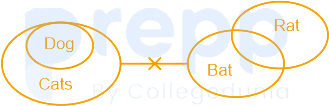
Conclusions:
(I) Some cats are rats → False (There is no direct relationship given between cats and rats, it's an indirect relation through bats, which doesn't necessarily conclude this).
(II) Some dogs are bats → False (Since all dogs are cats and no bat is a cat, this makes it impossible for any dog to be a bat).
(III) No dog is a bat → True (Since all dogs are cats and no bat is a cat, logically, no dog can be a bat).
So, Only Conclusion III Follows.
Hence, the correct answer is 'Option 4'.
Similar Questions
Read the given statements and conclusions carefully. Assuming that the information given in the statements is true, even if it appears to be at variance with commonly known facts, decide which of the given conclusions logically follow(s) from the statements.
Statements:
Some parks are hospitals.
Some hospitals are schools.
Some schools are colleges.
Conclusions:
I. Some parks are colleges.
II. All hospitals are schools.
III. No park is a college
Three statements are given, followed by three conclusions numbered I, II and III. Assuming the statements to be true, even if they seem to be at variance with commonly known facts, decide which of the conclusions logically follow(s) from the statements.
Statements:
All computers are footballs.
Some footballs are round.
Some round are stools.
Conclusions:
I. Some footballs are computers.
II. Some round are footballs.
III. Some stools are round.
Three statements are given followed by three conclusions I, II and III. Assuming that the information given in the statements is true, even if it seems to be at variance with commonly known facts, decide which of the given conclusions logically follows from the statements.
Statement :
No mug is bucket.
All mugs are cups.
Some cups are spoons.
Conclusion:
I. Some spoons are buckets.
II. Some mugs are spoons.
III. Some cups are not buckets.
Given below are three statements followed by three conclusions I, II and III. Considering the statements to be true, even if they seem to be at variance from commonly known facts, decide which of the conclusions logically follow(s) from the statements.
Statement :
All tanks are plates.
All cots are plates.
Some oats are cots.
Conclusion:
I. Some tanks are cots.
II. Some plates are tanks.
III. Some plates are oats.
Three statements are followed by three conclusions numbered I, II and III. You have to consider these statements to be true even if they seem to be at variance from commonly known facts. Decide which conclusion(s) logically follows from the given statements.
Statement :
No Pigeon is a Panduk.
Some Panduk are sparrows.
All sparrows are birds.
Conclusion:
(I) Some sparrows are not pigeons.
(II) Some sparrows are Panduk.
(III) Some birds are Panduk.
Three statements are followed by three conclusions numbered I, II and III. You have to consider these statements to be true, even if they seem to be at variance with commonly known facts. Decide which of the given conclusions logically follow(s) from the given statements.
Statements:
All bottles are plastics.
Some plastics are fibres.
Some fibres are glasses.
Conclusions:
(I) Some fibres are plastics.
(II) All plastics are bottles.
(III) Some glasses are fibres.
Read the given statements and conclusions carefully. Assuming that the information given in the statements is true, even if it appears to be at variance with commonly known facts, decide which of the given conclusions logically follow(s) from the statements.
Statements:
All pigeons are ants.
Some ants are birds.
All birds are cats.
Conclusions:
I. Some cats are pigeons.
II. Some birds are pigeons.
III. Some cats are ants.
In this question, three statements are given, followed by two conclusions numbered I and II. Assuming the statements to be true, even if they seem to be at variance with commonly known facts, decide which of the conclusions logically follows/follow from the statements.
Statements :
All candies are gems.
All gems are cakes.
Some cakes are sweets.
Conclusions :
I. All candies are cakes.
II. Some gems are sweets
Three statements are given, followed by three conclusions numbered I, II and III. Assuming the statements to be true, even if they seem to be at variance with commonly known facts, decide which of the conclusions logically follow(s) from the statements.
Statements:
All bottles are buildings.
Some buildings are short.
Some short are girls.
Conclusions:
I. Some buildings are bottles.
II. All buildings are short.
III. Some girls are short.
In this question, three statements are given, followed by two conclusions numbered I and II. Assuming the statements to be true, even if they seem to be at variance with commonly known facts, decide which of the conclusions logically follows/follow from the statements.
Statements:
I. Some gates are ways.
II. All ways are routes.
III. No route is a door.
Conclusions:
I. No door is a way.
II. Some gates are routes.
Important Questions from Conventional Syllogism
In this question, three statements followed by two conclusions numbered I and II have been given. You have to take the given statements to be true even if they seem to be at variance from the commonly facts and then decide which of the given conclusions logically follows from the given statements disregarding commonly known facts.
Statements: Some flats are apartments.
No apartment is a hall.
Some halls are rooms.
Conclusions: I. At least some rooms are flats.
II. No apartment is a room.
Read the given statements and conclusions carefully. Assuming that the information given in the statements is true, even if it appears to be at variance with commonly known facts, decide which of the given conclusions logically follow(s) from the statements.
Statements:
I. Some blue are red.
II. Some green are red.
Conclusions:
I. No blue is green.
II. No red is green.
Given below are two statements, Consider these statements to be true even if they seem factuality absurd, Read the conclusions and then decide which of the given conclusions logically follow(s) from the given statements?
Statements :
1. All vases are flowers.
2. No flowers is a plant.
Conclusions :
1. No vases is a plant.
2. Some plant are vases
In the question two statements are given, followed by three conclusions, I, II and III. You have to consider the statements to be true even if it seems to be at variance from commonly known facts. You have to decide which of the given conclusions, if any, follows from the given statements.
Statement 1 : Some cars are scooters.
Statement 2 : All scooters are buses.
Conclusion I : Some scooters are cars.
Conclusion II : Some buses are cars.
Conclusion III : All cars are buses.
Read the given statements and conclusions carefully. Assuming that the information in the statement is true even if they appear to be at variance with commonly known facts, choose the conclusion that logically follows from the statement beyond reasonable doubt.
Statement:-
1. Some dogs are cats.
2. All cats are birds.
Conclusion:-
1. Some dogs are birds.
2. No cat is dog.