
Initial Conditions Analysis
We are given two vessels containing an ideal gas, connected by a thin tube. The initial conditions are:
- Vessel 1: Volume $V_1$, Pressure $P_1 = 8 \text{ kPa}$, Temperature $T_1 = 1000 \text{ K}$.
- Vessel 2: Volume $V_2 = \frac{V_1}{2}$, Pressure $P_2 = 7 \text{ kPa}$, Temperature $T_2 = 500 \text{ K}$.
The ideal gas law states $PV = nRT$. We can express the number of moles ($n$) as $n = \frac{PV}{RT}$.
Calculating Initial Moles
Let $R$ be the ideal gas constant. The initial number of moles in each vessel are:
- Moles in Vessel 1 ($n_1$): $ n_1 = \frac{P_1 V_1}{R T_1} = \frac{(8 \text{ kPa}) V_1}{R (1000 \text{ K})} $
- Moles in Vessel 2 ($n_2$): $ n_2 = \frac{P_2 V_2}{R T_2} = \frac{(7 \text{ kPa}) (\frac{V_1}{2})}{R (500 \text{ K})} = \frac{(3.5 \text{ kPa}) V_1}{R (500 \text{ K})} = \frac{(7 \text{ kPa}) V_1}{R (1000 \text{ K})} $
The total initial moles ($n_{total}$) is the sum of moles in both vessels:
$ n_{total} = n_1 + n_2 = \frac{(8 \text{ kPa}) V_1}{R (1000 \text{ K})} + \frac{(7 \text{ kPa}) V_1}{R (1000 \text{ K})} = \frac{(15 \text{ kPa}) V_1}{R (1000 \text{ K})} $Final State Calculation
The vessels are connected, and the temperature is maintained at a final steady state temperature $T_f = 600 \text{ K}$. The total volume ($V_{total}$) becomes the sum of the individual volumes:
$ V_{total} = V_1 + V_2 = V_1 + \frac{V_1}{2} = \frac{3}{2} V_1 $At steady state, the total number of moles remains conserved ($n_{total}$). Applying the ideal gas law to the combined system at the final state ($P_f, V_{total}, T_f$):
$ P_f V_{total} = n_{total} R T_f $Substitute the expressions for $V_{total}$ and $n_{total}$:
$ P_f \left( \frac{3}{2} V_1 \right) = \left( \frac{15 \text{ kPa} V_1}{R (1000 \text{ K})} \right) R (600 \text{ K}) $Cancel out $V_1$ and $R$ from both sides:
$ P_f \left( \frac{3}{2} \right) = \frac{15 \text{ kPa} \times 600 \text{ K}}{1000 \text{ K}} $ $ P_f \left( \frac{3}{2} \right) = \frac{15 \text{ kPa} \times 6}{10} $ $ P_f \left( \frac{3}{2} \right) = 9 \text{ kPa} $Solve for the final pressure $P_f$:
$ P_f = 9 \text{ kPa} \times \frac{2}{3} $ $ P_f = 6 \text{ kPa} $Similar Questions
During the melting of a slab of ice at $273 \ K$ at atmospheric pressure:
- $\gamma_A$ is the specific heat ratio of monoatomic gas A having 3 translational degrees of freedom. $\gamma_B$ is the specific heat ratio of polyatomic gas B having 3 translational, 3 rotational degrees of freedom and 1 vibrational mode. If $\frac{\gamma_A}{\gamma_B} = \left(1 + \frac{1}{n}\right)$, then the value of n is _________.
- Match List - I with List - II.$\Delta Q$=Heat supplied
List - I List - II (A) Isobaric (I) $\Delta Q = \Delta W$ (B) Isochoric (II) $\Delta Q = \Delta U$ (C) Adiabatic (III) $\Delta Q = \text{zero}$ (D) Isothermal (IV) $\Delta Q = \Delta U + P\Delta V$
$\Delta W$ = Work done by the system
$\Delta U$=Change in internal energy
P = Pressure of the system
$\Delta V$ = Change in volume of the system
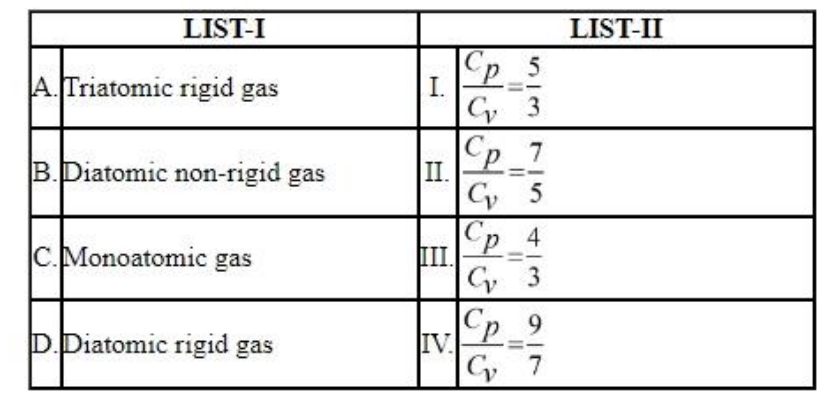
Choose the correct answer from the options given below : Match the LIST-I with LIST-II Choose the correct answer from the options given below:
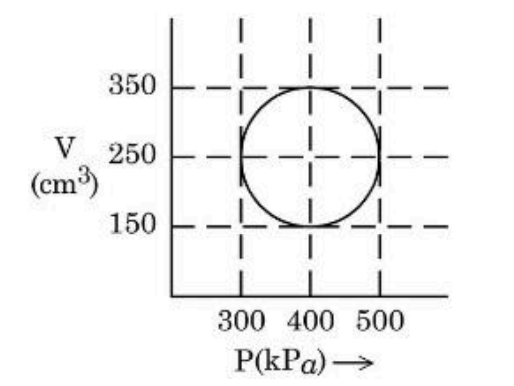
An ideal gas has undergone through the cyclic process as shown in the figure. Work done by the gas in the entire cycle is ________ $\times 10^{-1}$J.
(Take $\pi = 3.14$)
- An ideal gas exists in a state with pressure $P_0$, volume $V_0$. It is isothermally expanded to $4$ times of its initial volume($V_0$), then isobarically compressed to its original volume. Finally the system is heated isochorically to bring it to its initial state. The amount of heat exchanged in this process is
Water falls from a height of $200 \text{ m}$ into a pool. Calculate the rise in temperature of the water assuming no heat dissipation from the water in the pool.
(Take $g = 10 \text{ m/s}^2$, specific heat of water $= 4200 \text{ J/(kg K)}$)
A monoatomic gas having $\gamma = \frac{5}{3}$ is stored in a thermally insulated container and the gas is suddenly compressed to $\frac{1}{8}^{\text{th}}$ of its initial volume. The ratio of final pressure and initial pressure is:
($\gamma$ is the ratio of specific heats of the gas at constant pressure and at constant volume)
- A body takes 10 minutes to cool from $60^\circ C$ to $50^\circ C$. The temperature of surroundings is constant at $25^\circ C$. Then, the temperature of the body after next 10 minutes will be approximately :
- The value closest to the thermal velocity of a Helium atom at room temperature (300 K) in $ms^{-1}$ is : [$k_B = 1.4 \times 10^{-23}$ J/K; $m_{He} = 7 \times 10^{-27}$ kg]
Important Questions from Heat and Thermodynamics
During the melting of a slab of ice at $273 \ K$ at atmospheric pressure:
- $\gamma_A$ is the specific heat ratio of monoatomic gas A having 3 translational degrees of freedom. $\gamma_B$ is the specific heat ratio of polyatomic gas B having 3 translational, 3 rotational degrees of freedom and 1 vibrational mode. If $\frac{\gamma_A}{\gamma_B} = \left(1 + \frac{1}{n}\right)$, then the value of n is _________.
- Match List - I with List - II.$\Delta Q$=Heat supplied
List - I List - II (A) Isobaric (I) $\Delta Q = \Delta W$ (B) Isochoric (II) $\Delta Q = \Delta U$ (C) Adiabatic (III) $\Delta Q = \text{zero}$ (D) Isothermal (IV) $\Delta Q = \Delta U + P\Delta V$
$\Delta W$ = Work done by the system
$\Delta U$=Change in internal energy
P = Pressure of the system
$\Delta V$ = Change in volume of the system
Choose the correct answer from the options given below : Match the LIST-I with LIST-II Choose the correct answer from the options given below:
An ideal gas has undergone through the cyclic process as shown in the figure. Work done by the gas in the entire cycle is ________ $\times 10^{-1}$J.
(Take $\pi = 3.14$)


