
Ru3(CO)12 Bond Count
The structure of $\text{Ru}_3(\text{CO})_{12}$ consists of a triangle formed by three Ruthenium (Ru) metal atoms. Each side of this triangle represents a direct Ru-Ru metal-metal bond.
- Number of Ru-Ru bonds = 3
Co4(CO)12 Bond Count
The structure of $\text{Co}_4(\text{CO})_{12}$ is based on a tetrahedron formed by four Cobalt (Co) metal atoms. A tetrahedron has 6 edges, and each edge corresponds to a direct Co-Co metal-metal bond.
- Number of Co-Co bonds = 6
Total Metal-Metal Bonds
The total number of metal-metal bonds in $\text{Ru}_3(\text{CO})_{12}$ is 3, and in $\text{Co}_4(\text{CO})_{12}$ is 6.
Important Questions from Organometallic Chemistry
- The species that undergoes $\beta$-elimination is
The heptacity of allyl and Cp and the ligation mode of NO in the thermodynamically stable complexes
$[(\eta^x-allyl)Ru(CO)_2(NO)]$ and $[(\eta^y-Cp)Ru(CO)_2(NO)]$,
respectively, are
(The heptacity of allyl and Cp are denoted by $\eta^x$ and $\eta^y$, respectively.)The bond angle (Ti-C-C) in the crystal structure of
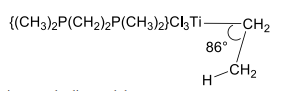
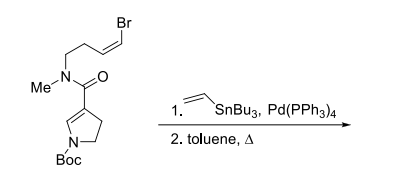
is severely distorted due toThe major product of the following reaction sequence is
Decarbonylation reaction of $[cis-(CH_3CO)Mn(^{13}CO)(CO)_4]$ yields X,Y and Z, where $X =[(CH_3)Mn(CO)_5]$; $Y = [cis-(CH_3)Mn(^{13}CO)(CO)_4]$; $Z = [trans-(CH_3)Mn(^{13}CO)(CO)_4]$
The molar ratio of the products(X : Y : Z) in this reaction is


