
Beta-Elimination in Organometallic Complexes
Beta-elimination is a crucial reaction pathway for alkyl metal complexes. It involves the transfer of a hydrogen atom from the β-carbon of the alkyl ligand to the metal center.
This process requires the presence of at least one hydrogen atom on the carbon atom positioned beta (β) relative to the metal-bound carbon (α-carbon).
The general equation is:
$ M-\underset{\alpha}{CH_2}-\underset{\beta}{CH_2}-H \rightarrow M-H + CH_2=CH_2 $
Analyzing Species for Beta-Elimination Capability
We assess the potential for β-elimination based on the organic ligands present:
- Option A: $[Rh(C_5H_5)(P(CH_3)_3)(C_2H_5)]^+$: This complex contains an ethyl ligand ($CH_3CH_2-$). The metal (Rh) is bonded to the $CH_2$ group (α-carbon). The adjacent $CH_3$ group is the β-carbon, which bears hydrogen atoms. Therefore, this species can undergo β-elimination.
- Option B: $[Rh(NH_3)_5(C_2H_5)]^{2+}$: This complex also contains an ethyl ligand ($CH_3CH_2-$), which typically facilitates β-elimination.
- Option C: $[Pt(P(C_6H_5)_3)_2(C_6H_5)I]$: The ligand is phenyl ($C_6H_5-$). Phenyl ligands lack a β-carbon atom relative to the metal-carbon bond, preventing β-elimination.
- Option D: $[Cr(CH_2Si(CH_3)_3)_4]$: The ligand is $CH_2Si(CH_3)_3-$. The atom adjacent to the α-carbon ($CH_2$) is Silicon (Si). Since there is no β-carbon atom, β-elimination cannot occur.
The complex $[Rh(C_5H_5)(P(CH_3)_3)(C_2H_5)]^+$ clearly possesses the required structural feature—an ethyl group with β-hydrogens—for β-elimination to proceed.
Important Questions from Organometallic Chemistry
The heptacity of allyl and Cp and the ligation mode of NO in the thermodynamically stable complexes
$[(\eta^x-allyl)Ru(CO)_2(NO)]$ and $[(\eta^y-Cp)Ru(CO)_2(NO)]$,
respectively, are
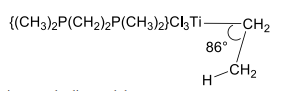
(The heptacity of allyl and Cp are denoted by $\eta^x$ and $\eta^y$, respectively.)The bond angle (Ti-C-C) in the crystal structure of
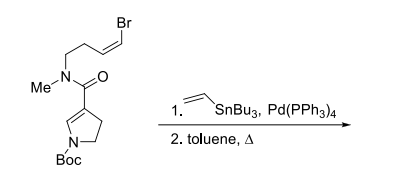
is severely distorted due toThe major product of the following reaction sequence is
Decarbonylation reaction of $[cis-(CH_3CO)Mn(^{13}CO)(CO)_4]$ yields X,Y and Z, where $X =[(CH_3)Mn(CO)_5]$; $Y = [cis-(CH_3)Mn(^{13}CO)(CO)_4]$; $Z = [trans-(CH_3)Mn(^{13}CO)(CO)_4]$
The molar ratio of the products(X : Y : Z) in this reaction is
The hapticity of cycloheptatriene, $(C_7H_8)$, in $Mo(C_7H_8)(CO)_3$ is ______________.


