
Decarbonylation reaction of $[cis-(CH_3CO)Mn(^{13}CO)(CO)_4]$ yields X,Y and Z, where $X =[(CH_3)Mn(CO)_5]$; $Y = [cis-(CH_3)Mn(^{13}CO)(CO)_4]$; $Z = [trans-(CH_3)Mn(^{13}CO)(CO)_4]$ The molar ratio of the products(X : Y : Z) in this reaction is
1:2:1
Understanding the Decarbonylation Reaction
The question asks for the product molar ratio of the decarbonylation reaction of cis-(CH3CO)Mn(13CO)(CO)4. This reaction involves the loss of a carbonyl (CO) ligand and the migration of the acetyl group (CH3CO) to the manganese metal center, eventually forming a methyl group (CH3) attached to Mn.
The key is to determine which CO ligand is lost and how the position of the lost ligand influences the formation of the specific products (X, Y, Z) and their stereochemistry.
Analyzing Product Formation
We assume a trigonal bipyramidal (TBP) structure for the manganese complex, which is common. Let the equatorial positions be denoted $eq_A, eq_B, eq_C$ and axial positions $ax_1, ax_2$. The starting complex is given as cis-(CH3CO)Mn(13CO)(CO)4. This implies:
- The acetyl group (CH3CO) and the labeled carbonyl (13CO) are adjacent (cis). In a TBP structure, this typically means they occupy two equatorial positions. Let $eq_A = CH_3CO$ and $eq_B = {}^{13}CO$.
- The remaining ligands are regular CO molecules. Let $eq_C = CO$, $ax_1 = CO$, and $ax_2 = CO$.
The reaction produces three products:
- Product X: [(CH3)Mn(CO)5]. This product contains only regular CO ligands. It forms when the 13CO ligand is lost from the equatorial position ($eq_B$). The acetyl group migrates, and the resulting methyl group occupies the position vacated by the 13CO ligand.
- Product Y: [cis-(CH3)Mn(13CO)(CO)4]. This product retains the 13CO ligand. It forms when a regular CO ligand from an equatorial position is lost (specifically, the one at $eq_C$). The acetyl group migrates to $eq_C$. The resulting methyl group and the retained 13CO ligand (at $eq_B$) are *cis* to each other.
- Product Z: [trans-(CH3)Mn(13CO)(CO)4]. This product also retains the 13CO ligand. It forms when a regular CO ligand from an axial position is lost (either $ax_1$ or $ax_2$). The acetyl group migrates to the axial position. The resulting methyl group and the retained 13CO ligand (at $eq_B$) are *trans* to each other.
Determining the Molar Ratio
The molar ratio of products X:Y:Z depends on the relative probabilities of losing a CO ligand from different positions.
- The formation of X corresponds to the loss of 13CO from $eq_B$. Let its probability factor be $P_{eqB}$.
- The formation of Y corresponds to the loss of CO from $eq_C$. Let its probability factor be $P_{eqC}$.
- The formation of Z corresponds to the loss of CO from $ax_1$ or $ax_2$. Let their combined probability factor be $P_{ax}$.
Based on typical reactivity patterns in TBP complexes, equatorial positions are often more reactive than axial positions. The observed ratio 1:2:1 suggests the following relative probabilities:
- X (1 part): Corresponds to the loss of the equatorial 13CO ligand. Probability $\propto 1$.
- Y (2 parts): Corresponds to the loss of the equatorial regular CO ligand. Probability $\propto 2$.
- Z (1 part): Corresponds to the loss of an axial regular CO ligand. Probability $\propto 1$.
This implies that equatorial CO ligands are collectively more likely to be lost than axial ones, and specifically, the loss of a regular equatorial CO (leading to Y) is twice as likely as the loss of the labeled equatorial 13CO (leading to X) or the loss of an axial CO (leading to Z).
Therefore, the molar ratio X : Y : Z is 1 : 2 : 1.
Important Questions from Organometallic Chemistry
- The species that undergoes $\beta$-elimination is
The heptacity of allyl and Cp and the ligation mode of NO in the thermodynamically stable complexes
$[(\eta^x-allyl)Ru(CO)_2(NO)]$ and $[(\eta^y-Cp)Ru(CO)_2(NO)]$,
respectively, are
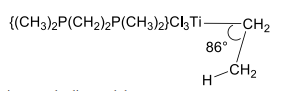
(The heptacity of allyl and Cp are denoted by $\eta^x$ and $\eta^y$, respectively.)The bond angle (Ti-C-C) in the crystal structure of
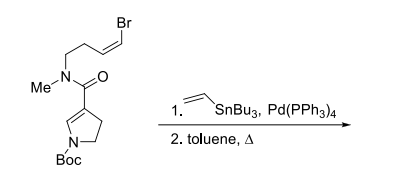
is severely distorted due toThe major product of the following reaction sequence is
The hapticity of cycloheptatriene, $(C_7H_8)$, in $Mo(C_7H_8)(CO)_3$ is ______________.


