
The heptacity of allyl and Cp and the ligation mode of NO in the thermodynamically stable complexes
$[(\eta^x-allyl)Ru(CO)_2(NO)]$ and $[(\eta^y-Cp)Ru(CO)_2(NO)]$,
respectively, are
(The heptacity of allyl and Cp are denoted by $\eta^x$ and $\eta^y$, respectively.)
Allyl Heptacity ($\eta^x$) Determination
The allyl ligand ($C_3H_5$) typically coordinates to a metal center through all three carbon atoms in organometallic complexes. This mode of binding is denoted as $\eta^3$.
- Allyl ligand heptacity: $\eta^3$
Cp Heptacity ($\eta^y$) Determination
The cyclopentadienyl ligand ($C_p$, $C_5H_5$) commonly binds to metals using all five carbon atoms, which is represented as $\eta^5$. This mode provides significant stabilization to the complex.
- Cp ligand heptacity: $\eta^5$
NO Ligation Mode Analysis
The nitrosyl (NO) ligand's coordination mode (linear or bent) influences its electronic contribution and the overall stability of the complex. The stability of the target complexes, $[(\eta^x\text{-allyl})Ru(CO)_2(NO)]$ and $[(\eta^y\text{-Cp})Ru(CO)_2(NO)]$, dictates the preferred NO binding.
- In $[(\eta^3\text{-allyl})Ru(CO)_2(NO)]$: The allyl ligand ($\eta^3$, 3e donor) and two CO ligands (2e + 2e donors) along with Ru (assumed Group 8, 8e). For stability, NO often acts as a linear, 2e donor (formally NO$^+$) in such systems, contributing to achieving favourable electron counts. Thus, NO is linear.
- In $[(\eta^5\text{-Cp})Ru(CO)_2(NO)]$: The Cp ligand ($\eta^5$, 5e donor) and two CO ligands (2e + 2e donors) along with Ru (8e). To satisfy the stable 18-electron rule (8 (Ru) + 5 (Cp) + 2 (CO) + 2 (CO) + 1 (NO$^-$) = 18e), the NO ligand typically binds in a bent fashion, acting as a 1e donor (formally NO$^-$). Thus, NO is bent.
Final Conclusion
Combining the determined heptacities and NO ligation modes:
- For $[(\eta^x\text{-allyl})Ru(CO)_2(NO)]$: ($\eta^3$, NO-linear)
- For $[(\eta^y\text{-Cp})Ru(CO)_2(NO)]$: ($\eta^5$, NO-bent)
Therefore, the correct combination is ($\eta^3$, NO-linear) and ($\eta^5$, NO-bent).
Important Questions from Organometallic Chemistry
- The species that undergoes $\beta$-elimination is
The bond angle (Ti-C-C) in the crystal structure of
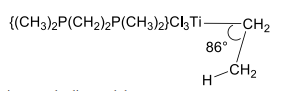
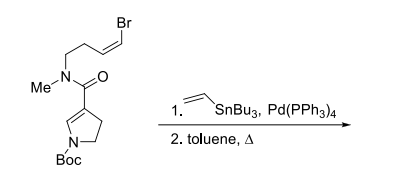
is severely distorted due toThe major product of the following reaction sequence is
Decarbonylation reaction of $[cis-(CH_3CO)Mn(^{13}CO)(CO)_4]$ yields X,Y and Z, where $X =[(CH_3)Mn(CO)_5]$; $Y = [cis-(CH_3)Mn(^{13}CO)(CO)_4]$; $Z = [trans-(CH_3)Mn(^{13}CO)(CO)_4]$
The molar ratio of the products(X : Y : Z) in this reaction is
The hapticity of cycloheptatriene, $(C_7H_8)$, in $Mo(C_7H_8)(CO)_3$ is ______________.


