
The bond angle (Ti-C-C) in the crystal structure of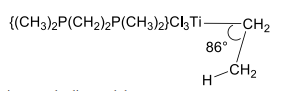
is severely distorted due to
The question involves understanding the cause of distortion in the bond angle (Ti-C-C) in the given crystal structure. The options provided are related to various interactions or factors that can influence molecular geometry.
Let's analyze each option:
- Hydrogen-bonding interaction: This typically occurs between hydrogen and electronegative atoms (such as oxygen, nitrogen, or fluorine). In the given compound, hydrogen bonding is unlikely to be the primary cause of the bond angle distortion since such interactions are not significant between the involved atoms in this context.
- Agostic interaction: This is an interaction where a C-H bond forms a three-center, two-electron bond with a metal center. The typical angle for agostic interactions is less than 90°, which can significantly distort bond angles. Given the structure and the presence of such a C-H interaction with the titanium center, this is a likely reason for the distorted Ti-C-C bond angle.
- Steric bulk of the phosphine ligand: While steric effects can influence molecular geometry, agostic interactions are more specific and potent causes of significant distortions in bond angles, as mentioned.
- Higher formal charge on metal: A higher charge can affect electronic distribution and bonding; however, it is not directly related to the observed angle distortion linked to agostic interactions.
Conclusion: The distortion in the bond angle (Ti-C-C) is most likely due to the agostic interaction, where the C-H bond interacts with the titanium center, causing a reduction in the bond angle.
Important Questions from Organometallic Chemistry
- The species that undergoes $\beta$-elimination is
The heptacity of allyl and Cp and the ligation mode of NO in the thermodynamically stable complexes
$[(\eta^x-allyl)Ru(CO)_2(NO)]$ and $[(\eta^y-Cp)Ru(CO)_2(NO)]$,
respectively, are
(The heptacity of allyl and Cp are denoted by $\eta^x$ and $\eta^y$, respectively.)The major product of the following reaction sequence is
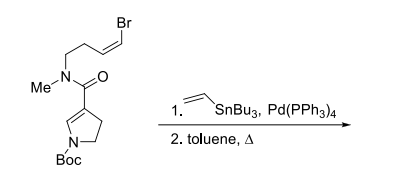
Decarbonylation reaction of $[cis-(CH_3CO)Mn(^{13}CO)(CO)_4]$ yields X,Y and Z, where $X =[(CH_3)Mn(CO)_5]$; $Y = [cis-(CH_3)Mn(^{13}CO)(CO)_4]$; $Z = [trans-(CH_3)Mn(^{13}CO)(CO)_4]$
The molar ratio of the products(X : Y : Z) in this reaction is
The hapticity of cycloheptatriene, $(C_7H_8)$, in $Mo(C_7H_8)(CO)_3$ is ______________.


