Equilibrium Separation Condition
The equilibrium separation ($R$) for atoms in a crystal occurs when the total energy ($E$) of the system is at its minimum. Mathematically, this minimum occurs when the derivative of the energy function with respect to the inter-atomic spacing is equal to zero ($ \frac{dE}{dR} = 0 $).
Calculating Equilibrium Spacing
The given total energy function is: $E(R) = \frac{0.5}{R^{12}} - \frac{1}{R^6}$
Rewrite the energy function using negative exponents for easier differentiation: $E(R) = 0.5 R^{-12} - R^{-6}$
Now, differentiate $E(R)$ with respect to $R$: $ \frac{dE}{dR} = \frac{d}{dR} (0.5 R^{-12}) - \frac{d}{dR} (R^{-6}) $ $ \frac{dE}{dR} = 0.5 \times (-12) R^{-12-1} - (-6) R^{-6-1} $ $ \frac{dE}{dR} = -6 R^{-13} + 6 R^{-7} $
Set the derivative equal to zero to find the equilibrium condition: $ -6 R^{-13} + 6 R^{-7} = 0 $
Rearrange the equation: $ 6 R^{-7} = 6 R^{-13} $ Divide both sides by 6: $ R^{-7} = R^{-13} $
To solve for $R$, multiply both sides by $ R^{13} $: $ R^{13} \times R^{-7} = R^{13} \times R^{-13} $ $ R^{13-7} = R^{13-13} $ $ R^6 = R^0 $ $ R^6 = 1 $
Since $R$ represents the inter-atomic spacing, it must be a positive value. Taking the sixth root of both sides gives: $ R = 1 $
The equilibrium separation between the atoms is 1.00 Angstroms.
Important Questions from Crystal Structure Bravais Lattices Unit Cell
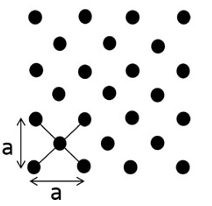
- For a two-dimensional hexagonal lattice with lattice constant $ a $, the atomic density is
- Consider a crystal that has a basis of one atom. Its primitive vectors are $ \vec{a_1} = a\hat{i} $, $ \vec{a_2} = a\hat{j} $, $ \vec{a_3} = \frac{a}{2}(\hat{i} + \hat{j} + \hat{k}) $, where $ \hat{i}, \hat{j}, \hat{k} $ are the unit vectors in the $ x, y $ and $ z $ directions of the Cartesian coordinate system and $ a $ is a positive constant. Which one of the following is the correct option regarding the type of the Bravais lattice?
- A compound consists of three ions X, Y and Z. The Z ions are arranged in an FCC arrangement. The X ions occupy $\frac{1}{6}$ of the tetrahedral voids and the Y ions occupy $\frac{1}{3}$ of the octahedral voids. Which one of the following is the CORRECT chemical formula of the compound?
For the given unit cells of a two dimensional square lattice, which option lists all the primitive cells?
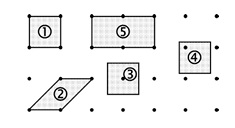
The number of distinct ways the primitive unit cell can be constructed for the two dimensional lattice as shown in the figure is ______.