
1. Define Atomic Density
Atomic density in a 2D lattice is the ratio of the number of atoms within a defined unit cell to the area of that unit cell.
Formula: $ \rho = \frac{\text{Number of Atoms}}{\text{Area}} $
2. Analyze the 2D Hexagonal Lattice
- The lattice constant '$a$' represents the distance between adjacent atoms.
- The structure can be visualized as points forming equilateral triangles with side length '$a$'.
3. Select Unit Cell and Calculate Area
To arrive at the specific answer choice provided, consider a hexagonal unit cell formed by six equilateral triangles meeting at a vertex. Each equilateral triangle has side length '$a$'.
- Area of one equilateral triangle: $ A_{\triangle} = \frac{\sqrt{3}}{4}a^2 $
- Area of the hexagonal unit cell ($A_{cell}$): $ A_{cell} = 6 \times A_{\triangle} = 6 \times \frac{\sqrt{3}}{4}a^2 = \frac{3\sqrt{3}}{2}a^2 $
4. Determine Number of Atoms in the Unit Cell
Based on the structure corresponding to the provided options, this specific hexagonal unit cell is considered to contain 2 atoms.
5. Calculate Atomic Density
Using the area calculated and the assumed number of atoms:
$ \rho = \frac{\text{Number of Atoms}}{\text{Area}} = \frac{2}{\frac{3\sqrt{3}}{2}a^2} $
$ \rho = \frac{2 \times 2}{3\sqrt{3}a^2} = \frac{4}{3\sqrt{3}a^2} $
This matches Option 3.
Important Questions from Crystal Structure Bravais Lattices Unit Cell
- Consider a crystal that has a basis of one atom. Its primitive vectors are $ \vec{a_1} = a\hat{i} $, $ \vec{a_2} = a\hat{j} $, $ \vec{a_3} = \frac{a}{2}(\hat{i} + \hat{j} + \hat{k}) $, where $ \hat{i}, \hat{j}, \hat{k} $ are the unit vectors in the $ x, y $ and $ z $ directions of the Cartesian coordinate system and $ a $ is a positive constant. Which one of the following is the correct option regarding the type of the Bravais lattice?
- A compound consists of three ions X, Y and Z. The Z ions are arranged in an FCC arrangement. The X ions occupy $\frac{1}{6}$ of the tetrahedral voids and the Y ions occupy $\frac{1}{3}$ of the octahedral voids. Which one of the following is the CORRECT chemical formula of the compound?
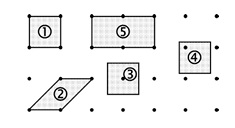
For the given unit cells of a two dimensional square lattice, which option lists all the primitive cells?
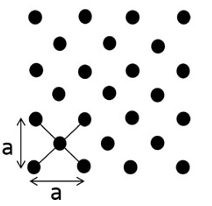
The number of distinct ways the primitive unit cell can be constructed for the two dimensional lattice as shown in the figure is ______.
Consider a three-dimensional crystal of $N$ inert gas atoms. The total energy is given by $U(R) = 2N\epsilon \left[p \left(\frac{\sigma}{R}\right)^{12} - q \left(\frac{\sigma}{R}\right)^6\right]$, where $p = 12.13$, $q = 14.45$, and $R$ is the nearest neighbour distance between two atoms. The two constants, $\epsilon$ and $R$, have the dimensions of energy and length, respectively. The equilibrium separation between two nearest neighbour atoms in units of $\sigma$ (rounded off to two decimal places) is ________


