
The number of distinct ways the primitive unit cell can be constructed for the two dimensional lattice as shown in the figure is ______.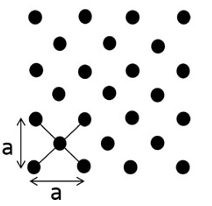
The task is to determine the number of distinct ways the primitive unit cell can be constructed for a two-dimensional lattice. A primitive unit cell is the smallest repeating unit in a lattice that, when translated through the lattice vectors, can fully fill the entire lattice structure without overlaps or gaps.
Given the lattice pattern in the figure, let's analyze:
- The lattice depicted is a simple square lattice. Each lattice point has its nearest neighbors at equal distances along the axes.
- For a square lattice, the primitive unit cell is typically a square formed by the closest lattice points. However, different primitive units can be selected by connecting pairs of lattice points in such a way that they still cover all lattice points through translation.
Possible primitive vectors are combinations that connect one lattice point to any of its nearest neighbors. Considering rotations (e.g., 45-degree rotations of the square unit) and reflections, you can form identical primitive cells with the same types of vectors. Let's determine the distinct combinations:
- A typical method is choosing two perpendicular vectors:
aanda. - You can rotate these vectors by 45 degrees to form a basis with vectors of length
√2aand directions diagonal to the axes. - Reflections and other orientations (e.g., horizontal vs. vertical) do not produce new distinct primitive cells due to symmetry in the square lattice.
Thus, by logical enumeration and symmetry considerations, the number of distinct primitive cells is found to be 5.
Finally, verifying the range requirement: the calculated number of distinct unit cells, 5, conforms to the given range of 5,5.
Important Questions from Crystal Structure Bravais Lattices Unit Cell
- For a two-dimensional hexagonal lattice with lattice constant $ a $, the atomic density is
- Consider a crystal that has a basis of one atom. Its primitive vectors are $ \vec{a_1} = a\hat{i} $, $ \vec{a_2} = a\hat{j} $, $ \vec{a_3} = \frac{a}{2}(\hat{i} + \hat{j} + \hat{k}) $, where $ \hat{i}, \hat{j}, \hat{k} $ are the unit vectors in the $ x, y $ and $ z $ directions of the Cartesian coordinate system and $ a $ is a positive constant. Which one of the following is the correct option regarding the type of the Bravais lattice?
- A compound consists of three ions X, Y and Z. The Z ions are arranged in an FCC arrangement. The X ions occupy $\frac{1}{6}$ of the tetrahedral voids and the Y ions occupy $\frac{1}{3}$ of the octahedral voids. Which one of the following is the CORRECT chemical formula of the compound?
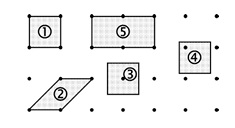
For the given unit cells of a two dimensional square lattice, which option lists all the primitive cells?
Consider a three-dimensional crystal of $N$ inert gas atoms. The total energy is given by $U(R) = 2N\epsilon \left[p \left(\frac{\sigma}{R}\right)^{12} - q \left(\frac{\sigma}{R}\right)^6\right]$, where $p = 12.13$, $q = 14.45$, and $R$ is the nearest neighbour distance between two atoms. The two constants, $\epsilon$ and $R$, have the dimensions of energy and length, respectively. The equilibrium separation between two nearest neighbour atoms in units of $\sigma$ (rounded off to two decimal places) is ________


