
For the given unit cells of a two dimensional square lattice, which option lists all the primitive cells?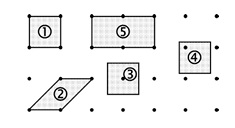
1,2,3 and 4
Here is the solution for the given problem:
To determine which unit cells are primitive cells in a two-dimensional square lattice, we need to understand what a primitive cell is.
A primitive cell is the smallest unit cell of a lattice that, when repeated, can reproduce the entire lattice. It contains exactly one lattice point.
Let’s analyze the options in the image:
- Option 1: This is a square unit cell, typical of a simple square lattice. It contains one lattice point.
- Option 2: This is a parallelogram, which can also serve as a primitive cell in a square lattice by containing one lattice point.
- Option 3: This smaller square also contains one lattice point and can be repeated to form the lattice.
- Option 4: Another square, rotated but containing one lattice point, suitable for a primitive cell.
- Option 5: This rectangle covers more than one lattice point, therefore it is not a primitive cell.
Thus, the primitive cells in this lattice are options 1, 2, 3, and 4. These can all tile the lattice without leaving gaps or overlapping other cells.
Therefore, the correct answer is: 1, 2, 3, and 4.
Important Questions from Crystal Structure Bravais Lattices Unit Cell
- For a two-dimensional hexagonal lattice with lattice constant $ a $, the atomic density is
- Consider a crystal that has a basis of one atom. Its primitive vectors are $ \vec{a_1} = a\hat{i} $, $ \vec{a_2} = a\hat{j} $, $ \vec{a_3} = \frac{a}{2}(\hat{i} + \hat{j} + \hat{k}) $, where $ \hat{i}, \hat{j}, \hat{k} $ are the unit vectors in the $ x, y $ and $ z $ directions of the Cartesian coordinate system and $ a $ is a positive constant. Which one of the following is the correct option regarding the type of the Bravais lattice?
- A compound consists of three ions X, Y and Z. The Z ions are arranged in an FCC arrangement. The X ions occupy $\frac{1}{6}$ of the tetrahedral voids and the Y ions occupy $\frac{1}{3}$ of the octahedral voids. Which one of the following is the CORRECT chemical formula of the compound?
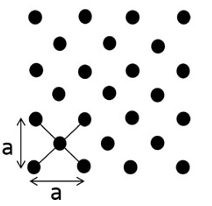
The number of distinct ways the primitive unit cell can be constructed for the two dimensional lattice as shown in the figure is ______.
Consider a three-dimensional crystal of $N$ inert gas atoms. The total energy is given by $U(R) = 2N\epsilon \left[p \left(\frac{\sigma}{R}\right)^{12} - q \left(\frac{\sigma}{R}\right)^6\right]$, where $p = 12.13$, $q = 14.45$, and $R$ is the nearest neighbour distance between two atoms. The two constants, $\epsilon$ and $R$, have the dimensions of energy and length, respectively. The equilibrium separation between two nearest neighbour atoms in units of $\sigma$ (rounded off to two decimal places) is ________


