
Calculate Bravais Lattice Primitive Cell Volume
The volume $ V $ of a primitive cell defined by primitive vectors $ \vec{a_1}, \vec{a_2}, \vec{a_3} $ is given by the scalar triple product:
$ V = |(\vec{a_1} \times \vec{a_2}) \cdot \vec{a_3}| $
Given the primitive vectors:
- $ \vec{a_1} = a\hat{i} $
- $ \vec{a_2} = a\hat{j} $
- $ \vec{a_3} = \frac{a}{2}(\hat{i} + \hat{j} + \hat{k}) $
First, calculate the cross product $ \vec{a_1} \times \vec{a_2} $:
$ \vec{a_1} \times \vec{a_2} = (a\hat{i}) \times (a\hat{j}) = a^2 (\hat{i} \times \hat{j}) = a^2 \hat{k} $
Next, calculate the dot product with $ \vec{a_3} $:
$ (\vec{a_1} \times \vec{a_2}) \cdot \vec{a_3} = (a^2 \hat{k}) \cdot \left(\frac{a}{2}(\hat{i} + \hat{j} + \hat{k})\right) $
$ = \frac{a^3}{2} (\hat{k} \cdot \hat{i} + \hat{k} \cdot \hat{j} + \hat{k} \cdot \hat{k}) $
Since $ \hat{i}, \hat{j}, \hat{k} $ are orthogonal unit vectors ($ \hat{k} \cdot \hat{i} = 0 $, $ \hat{k} \cdot \hat{j} = 0 $, $ \hat{k} \cdot \hat{k} = 1 $):
$ = \frac{a^3}{2} (0 + 0 + 1) = \frac{a^3}{2} $
The volume of the primitive cell is $ V = \left|\frac{a^3}{2}\right| = \frac{a^3}{2} $.
Identify Bravais Lattice Type
The given primitive vectors $ \vec{a_1} = a\hat{i} $, $ \vec{a_2} = a\hat{j} $, and $ \vec{a_3} = \frac{a}{2}(\hat{i} + \hat{j} + \hat{k}) $ are characteristic of a Body-Centered Cubic (BCC) lattice.
Specifically, for a BCC lattice with a conventional cubic lattice parameter $ a_{conv} $, the primitive vectors can be expressed, for example, as:
- $ \vec{p_1} = \frac{a_{conv}}{2}(\hat{i} + \hat{j} - \hat{k}) $
- $ \vec{p_2} = \frac{a_{conv}}{2}(\hat{i} - \hat{j} + \hat{k}) $
- $ \vec{p_3} = \frac{a_{conv}}{2}(-\hat{i} + \hat{j} + \hat{k}) $
By taking linear combinations of these vectors, we can show that the given vectors $ \vec{a_1}, \vec{a_2}, \vec{a_3} $ correspond to the BCC lattice if $ a_{conv} = a $:
- $ \vec{a_1} = a\hat{i} = \vec{p_1} + \vec{p_2} $ (using $ a_{conv}=a $)
- $ \vec{a_2} = a\hat{j} = \vec{p_1} + \vec{p_3} $ (using $ a_{conv}=a $)
- $ \vec{a_3} = \frac{a}{2}(\hat{i} + \hat{j} + \hat{k}) = \vec{p_1} + \vec{p_2} + \vec{p_3} $ (using $ a_{conv}=a $)
Furthermore, the volume of the primitive cell for a BCC lattice is $ V_{BCC} = \frac{a_{conv}^3}{2} $. Since our calculated volume is $ \frac{a^3}{2} $, this implies $ a_{conv} = a $, consistent with the BCC identification. For FCC, the primitive cell volume is $ V_{FCC} = \frac{a_{conv}^3}{4} $, which would not match our calculated volume $ \frac{a^3}{2} $ for any reasonable $ a_{conv} $ relative to the given vectors.
Therefore, the crystal lattice is BCC and the volume of its primitive cell is $ \frac{a^3}{2} $.
Important Questions from Crystal Structure Bravais Lattices Unit Cell
- For a two-dimensional hexagonal lattice with lattice constant $ a $, the atomic density is
- A compound consists of three ions X, Y and Z. The Z ions are arranged in an FCC arrangement. The X ions occupy $\frac{1}{6}$ of the tetrahedral voids and the Y ions occupy $\frac{1}{3}$ of the octahedral voids. Which one of the following is the CORRECT chemical formula of the compound?
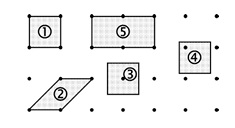
For the given unit cells of a two dimensional square lattice, which option lists all the primitive cells?
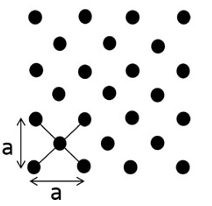
The number of distinct ways the primitive unit cell can be constructed for the two dimensional lattice as shown in the figure is ______.
Consider a three-dimensional crystal of $N$ inert gas atoms. The total energy is given by $U(R) = 2N\epsilon \left[p \left(\frac{\sigma}{R}\right)^{12} - q \left(\frac{\sigma}{R}\right)^6\right]$, where $p = 12.13$, $q = 14.45$, and $R$ is the nearest neighbour distance between two atoms. The two constants, $\epsilon$ and $R$, have the dimensions of energy and length, respectively. The equilibrium separation between two nearest neighbour atoms in units of $\sigma$ (rounded off to two decimal places) is ________


