
The three position of a dice is given below Choose figure will be formed when the dice is unfolded?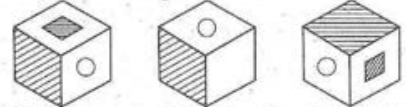
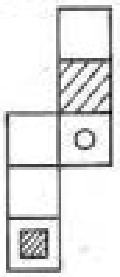
The three views show the same faces: a diagonally hatched face, a face with a small circle and a face with a small shaded square (it looks like a diamond when seen on top). The hatched, circle and shaded-square faces meet at one corner in the first and third views, so none of these three faces is opposite another.
In the net where the shaded square and the hatched face sit at the two ends of one straight strip of three, they would be opposite faces, and in the net where the circle and shaded square are separated by one square in a line, they would be opposite; both contradict the views.
The remaining two nets keep all three faces adjacent, but folding shows that only one of them gives the same clockwise order (shaded square, circle, hatched) seen around the corner in the first view. The other net gives the mirror order.
So only the net in which the hatched face sits above the circle face, with the shaded square at the far end of the side strip, folds into this dice.
Hence, the net with the hatched face directly above the circle face and the shaded square at the far end.
Similar Questions
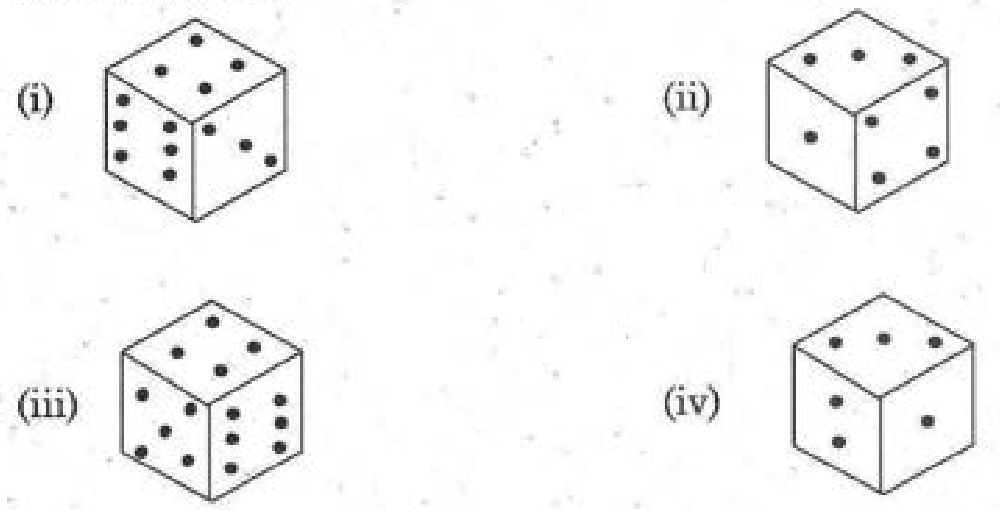
How many dots are there on the dice face opposite to the dice face with three dots?
Important Questions from Cube and Dice
A cube of side 4 cm is painted green on all its faces and then divided into smaller cubes of side 2 cm each. How many small cubes have been obtained?
Two adjacent faces of a solid cube are painted with black colour. The faces opposite to the black faces is painted with blue colour while the remaining faces are painted with yellow colour. After painting, this cube has been divided into 125 equal cubes. How many cubes have no faces painted?
A cube, whose two adjacent faces are coloured, is cut into 64 identical small cubes. How many of these small cubes are not coloured at all?
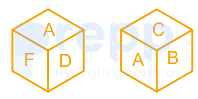
Two different positions of the same dice are shown, the six faces of which are marked with the letters A to F. Select the letter that will be on the face opposite to the one having A.
A Cube is coloured blue on all the faces. It is then cut into 64 smaller cubes. These cubes are now separated. The number of smaller cubes with no surface coloured is:



