
In a dice, each face is numbered as follows: 1) 4 is opposite to 2 2) 5 is opposite to 3 3) 1 is opposite to 6 Which of the following is definitely false? A) 1 is not adjacent to 5 and 3 B) 4 is adjacent to 3 C) 4 is adjacent to 5 D) 2 is adjacent to 1
Dice Adjacency Rules
This solution determines which statement is definitely false based on the specific opposite face pairings provided for a dice.
Faces Definition
On a dice, each face has one unique opposite face and four adjacent faces. A face cannot be adjacent to itself or its opposite.
Opposite Pairs Defined
The problem states the following opposite face pairs:
- (4, 2)
- (5, 3)
- (1, 6)
Statement A Analysis
Statement: 1 is not adjacent to 5 and 3.
Faces adjacent to 1 are all faces except 1 and its opposite (6). Thus, adjacent faces are {2, 3, 4, 5}.
The statement requires both "1 is not adjacent to 5" AND "1 is not adjacent to 3" to be true.
However, 1 IS adjacent to 5, and 1 IS adjacent to 3.
Therefore, the statement "1 is not adjacent to 5 and 3" is false.
Statement B Analysis
Statement: 4 is adjacent to 3.
Faces adjacent to 4 are all faces except 4 and its opposite (2). These are {1, 3, 5, 6}.
Since 3 is in this set, the statement "4 is adjacent to 3" is true.
Statement C Analysis
Statement: 4 is adjacent to 5.
Faces adjacent to 4 are {1, 3, 5, 6}.
Since 5 is in this set, the statement "4 is adjacent to 5" is true.
Statement D Analysis
Statement: 2 is adjacent to 1.
Faces adjacent to 2 are all faces except 2 and its opposite (4). These are {1, 3, 5, 6}.
Since 1 is in this set, the statement "2 is adjacent to 1" is true.
False Statement Conclusion
The question asks for the statement that is definitely false.
Statement A is the only statement identified as false.
Important Questions from Cube and Dice
- In a dice, each face is numbered as follows:
1) U is opposite to Z
2) X is opposite to V
3) Y is opposite to W
Which of the following is definitely false?
A) V is not adjacent to Y and W
B) V is adjacent to U
C) W is adjacent to X
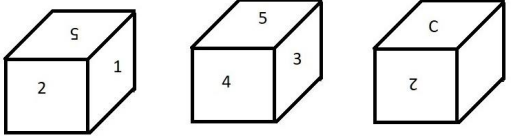
D) Y is adjacent to Z A dice is numbered from 1 to 6. Based on the three images of dice, find out which of the following numbers comes in the place of C.
- In a dice, each face is marked as follows:
1) * is adjacent to ^
2)^ is opposite to #
3) @ is opposite to $
4)! is adjacent to ^
Which of the following is definitely true?
A) * is between $ and ^
B) * is adjacent to !
C) ^ is between * and !
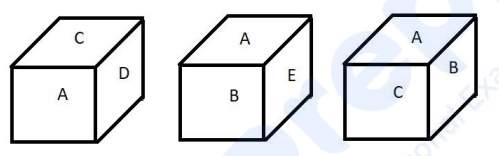
D) # is between ^ and @ The dice contains A, B, C, D, E, F on the six faces. Which alphabet is opposite to E?
In a dice, each face is numbered as follows:
1) 2 is adjacent to 3
2) 3 is opposite to 1
3) 5 is opposite to 4
4) 6 is adjacent to 3
Which of the following is definitely true?
A) 2 is between 4 and 3
B) 2 is adjacent to 6
C) 3 is between 2 and 6
D) 1 is between 3 and 5


