The ternary diagram given below shows phase relations for the Anorthite-Diopside-Forsterite system at 1 bar pressure. Broken lines represent isotherms with temperature in $^{\circ}\text{C}$. If 'P' is the initial melt composition, which one of the following is the CORRECT sequence of crystallization assuming equilibrium between crystal and melt?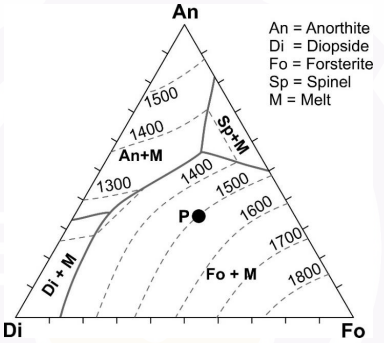
The question requires understanding the crystallization sequence of the Anorthite-Diopside-Forsterite (An-Di-Fo) system at 1 bar pressure, starting from a specific melt composition labeled 'P' on the ternary phase diagram.
- The initial composition 'P' is located in the Fo + M region, indicating that Fo (Forsterite) will crystallize first from the melt.
- Upon further cooling, we move along the temperature gradients marked by isotherms. As the temperature decreases further, we reach the Fo + An boundary.
- At this boundary, An (Anorthite) starts to crystallize along with Fo, indicating the next segment in the sequence is Fo + An.
- Continuing the cooling process, we approach the region labeled Fo + An + Di.
The correct crystallization sequence based on the phase diagram is: [Fo] → [Fo + An] → [Fo + An + Di].
Other options are incorrect because they involve crystallization sequences not supported by the phase regions crossed by the cooling path of the initial composition 'P'.
Important Questions from Igneous Petrology (Binary and Ternary Phase Diagrams)
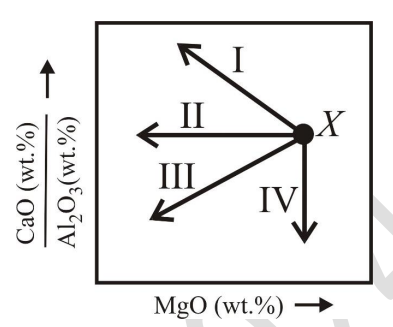
If 'X' represents the initial composition of a melt, which one of the trends indicated by arrows in the schematic diagram corresponds to the evolution of the residual melt composition during crystallization of diopside?
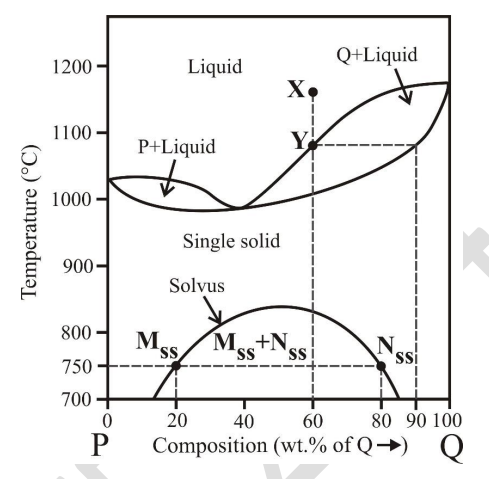
The diagram given below shows phase relations between components P and Q at 1 bar pressure. If ‘X' represents the initial liquid composition, which of the following statements is/are CORRECT during equilibrium crystallization?
- Choose the CORRECT statement regarding crystallization of a single feldspar of composition $Or_{50}Ab_{50}$ in the Albite-Orthoclase system.
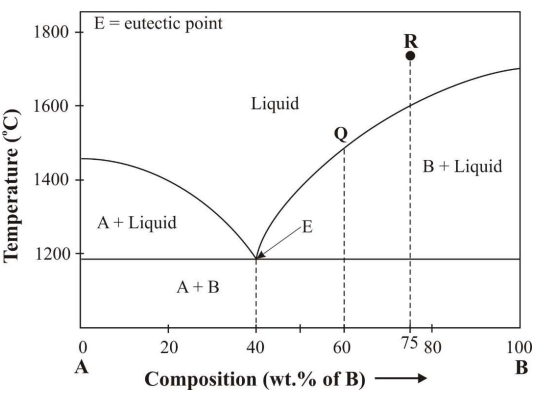
The following diagram shows phase relations in a system consisting of components A and B at 1 bar pressure. If the initial composition of liquid is R, during cooling and crystallization of magma, which of the following statement(s) is/are CORRECT?
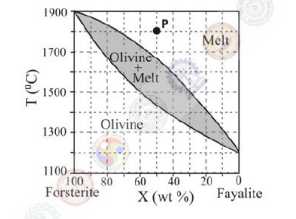
The given T-X diagram shows the phase relations in olivine solid solution at 1 bar pressure. If 'P' is the initial position of melt, the proportion of melt at $1500^\circ$C is __________ %.