Feldspar Crystallization Explained
This question concerns the crystallization behavior of a specific feldspar composition, $Or_{50}Ab_{50}$, within the Albite-Orthoclase (Ab-Or) system under different conditions: hypersolvus and subsolvus.
Understanding the Ab-Or System and Solvus
The Albite ($Ab$) and Orthoclase ($Or$) end-members form a binary system. At high temperatures, they form a complete solid solution series, meaning any intermediate composition can exist as a single, homogeneous mineral phase. However, at lower temperatures, a solvus develops. The solvus is a boundary curve on a phase diagram that separates the field where a single solid solution exists from the field where two separate solid phases coexist.
- For the Ab-Or system, the solvus indicates that intermediate compositions like $Or_{50}Ab_{50}$ cannot remain as a single homogeneous phase if the temperature drops below the solvus.
Hypersolvus vs. Subsolvus Conditions
These terms describe the crystallization environment concerning the solvus:
- Hypersolvus crystallization: Occurs when a single feldspar phase crystallizes from a melt. This typically happens at temperatures above the solvus or under conditions (like rapid cooling) that prevent the system from crossing the solvus and exsolving upon cooling. A single feldspar phase can therefore form and potentially persist.
- Subsolvus crystallization: Involves initial crystallization of a single feldspar solid solution phase at high temperatures (above the solvus). However, subsequent slow cooling allows the temperature to drop below the solvus, causing this single phase to become unstable and exsolve into two distinct phases: one rich in $Or$ and the other rich in $Ab$.
Crystallization of $Or_{50}Ab_{50}$
Consider the composition $Or_{50}Ab_{50}$:
- This intermediate composition exists as a single homogeneous feldspar phase only when the temperature is above the solvus.
- In a hypersolvus system, the crystallization can occur entirely above the solvus, allowing the $Or_{50}Ab_{50}$ mineral to form as a single phase.
- In a subsolvus system, although the $Or_{50}Ab_{50}$ phase initially forms above the solvus, slow cooling inevitably causes it to cross the solvus and exsolve into separate $Or$-rich and $Ab$-rich phases. Therefore, the single homogeneous $Or_{50}Ab_{50}$ mineral does not represent the final stable state and cannot be considered to "form" (and remain) in a subsolvus system.
Thus, the single feldspar of composition $Or_{50}Ab_{50}$ can form in a hypersolvus system but not typically persist as a single phase in a subsolvus system due to exsolution.
Important Questions from Igneous Petrology (Binary and Ternary Phase Diagrams)
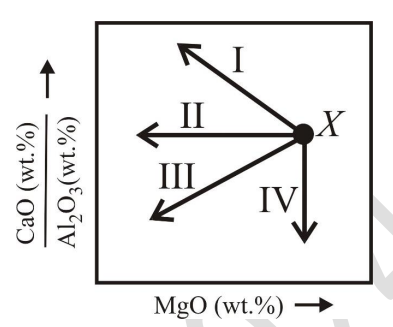
If 'X' represents the initial composition of a melt, which one of the trends indicated by arrows in the schematic diagram corresponds to the evolution of the residual melt composition during crystallization of diopside?
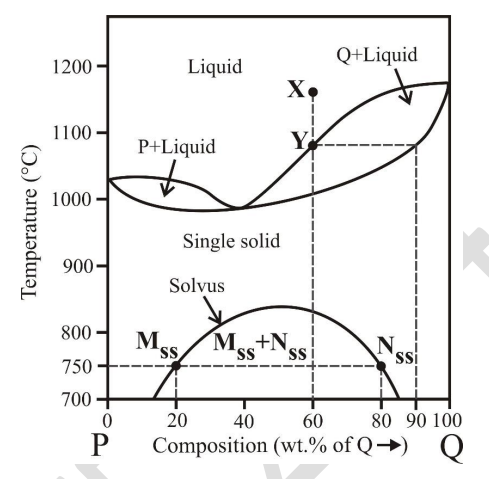
The diagram given below shows phase relations between components P and Q at 1 bar pressure. If ‘X' represents the initial liquid composition, which of the following statements is/are CORRECT during equilibrium crystallization?
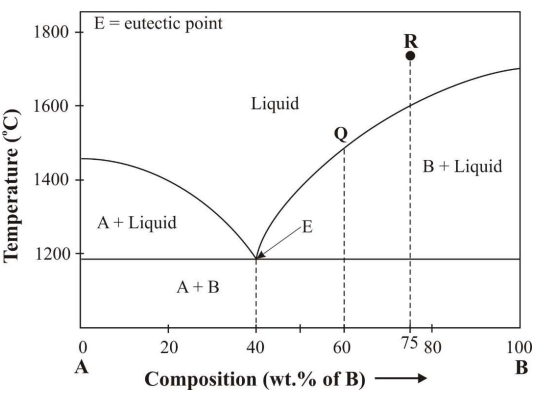
The following diagram shows phase relations in a system consisting of components A and B at 1 bar pressure. If the initial composition of liquid is R, during cooling and crystallization of magma, which of the following statement(s) is/are CORRECT?
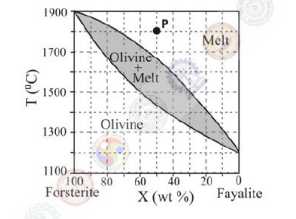
The given T-X diagram shows the phase relations in olivine solid solution at 1 bar pressure. If 'P' is the initial position of melt, the proportion of melt at $1500^\circ$C is __________ %.
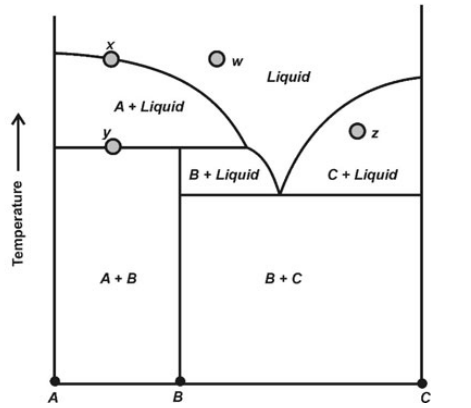
The figure below represents an isobaric binary liquidus phase diagram, with the solid phases A, B and C. What are the degrees of freedom associated with equilibrium phase assemblages represented by the bulk compositions w, x, y and z, in the fields indicated in the figure?