If 'X' represents the initial composition of a melt, which one of the trends indicated by arrows in the schematic diagram corresponds to the evolution of the residual melt composition during crystallization of diopside?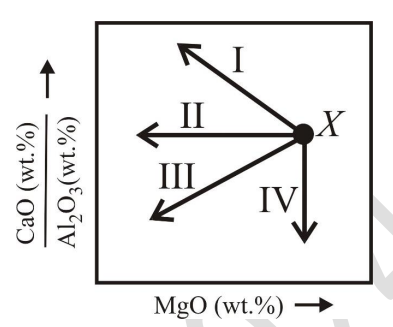
The given question involves understanding the trends in the evolution of residual melt composition during the crystallization of diopside, a type of clinopyroxene. Diopside has a chemical formula of CaMgSi2O6 and is known to selectively incorporate certain elements as it crystallizes from a melt.
The schematic diagram provided indicates various compositional trends with arrows labeled I to IV. As diopside crystallizes from the initial melt composition 'X', it will preferentially remove certain oxides from the melt:
- Diopside primarily incorporates CaO and MgO into its structure while crystallizing.
- As diopside crystallizes, MgO and CaO are depleted from the remaining melt.
Let's analyze the trends:
- Option I: This arrow shows an increase in CaO and an increase in Al2O3, which does not align with the conditions since diopside uses CaO.
- Option II: This arrow depicts a moderate decrease in CaO and an increase in Al2O3, which is not accurate either.
- Option III: This trend indicates a decrease in both MgO and CaO, which aligns with the crystallization of diopside since both these components are removed from the melt.
- Option IV: This arrow depicts a decrease in MgO and CaO while possibly enhancing another component, but is more aligned with the exchange of MgO.
Thus, during the crystallization of diopside, the components "CaO" and "MgO" are removed from the melt. Hence, the correct choice is Option III
Important Questions from Igneous Petrology (Binary and Ternary Phase Diagrams)
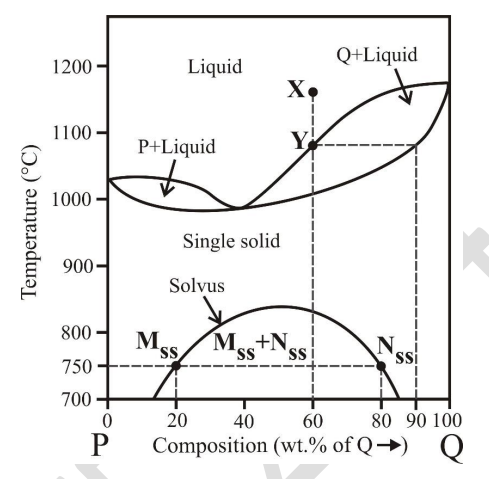
The diagram given below shows phase relations between components P and Q at 1 bar pressure. If ‘X' represents the initial liquid composition, which of the following statements is/are CORRECT during equilibrium crystallization?
- Choose the CORRECT statement regarding crystallization of a single feldspar of composition $Or_{50}Ab_{50}$ in the Albite-Orthoclase system.
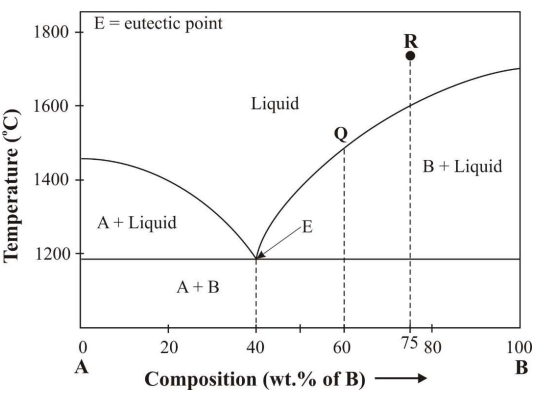
The following diagram shows phase relations in a system consisting of components A and B at 1 bar pressure. If the initial composition of liquid is R, during cooling and crystallization of magma, which of the following statement(s) is/are CORRECT?
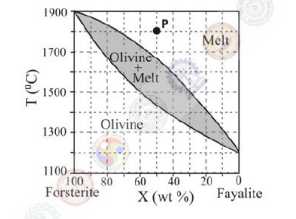
The given T-X diagram shows the phase relations in olivine solid solution at 1 bar pressure. If 'P' is the initial position of melt, the proportion of melt at $1500^\circ$C is __________ %.
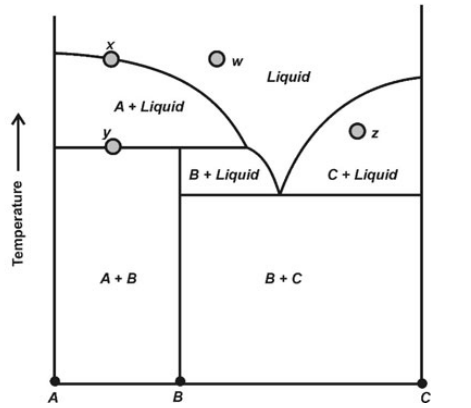
The figure below represents an isobaric binary liquidus phase diagram, with the solid phases A, B and C. What are the degrees of freedom associated with equilibrium phase assemblages represented by the bulk compositions w, x, y and z, in the fields indicated in the figure?