
The simplest possible POS form of $F(A, B, C, D, E)$ $=\sum m (6, 9, 13, 18, 19, 25, 27, 29, 31)$$+d(2, 3, 11, 15, 17, 24, 28)$ is
$(D+E)(\overline{B}+E)(A+B+\overline{E})(\overline{A}+B+\overline{C})$
POS Simplification Problem
The objective is to determine the simplest Product of Sums (POS) expression for the Boolean function $F(A, B, C, D, E)$, given its minterms and don't-care conditions.
- Function definition: $F(A, B, C, D, E) = \sum m (6, 9, 13, 18, 19, 25, 27, 29, 31) + d(2, 3, 11, 15, 17, 24, 28)$.
- POS form requires identifying and grouping the zeros (Maxterms) of the function.
Maxterms Identification
For a 5-variable function, there are $2^5 = 32$ minterms (indexed from 0 to 31).
- Minterms where $F=1$: {6, 9, 13, 18, 19, 25, 27, 29, 31}.
- Don't-care minterms: {2, 3, 11, 15, 17, 24, 28}.
- The Maxterms (where $F$ must be 0) are all other minterms: {0, 1, 4, 5, 7, 8, 10, 12, 14, 16, 20, 21, 22, 23, 26, 30}.
K-map Grouping for POS Form
A 5-variable Karnaugh map (K-map) is used to simplify the function. In POS simplification, we group the cells containing 0s (Maxterms). Don't care marks (X) can be included in groups to maximize their size.
Each minimal group of 0s (potentially including Xs) corresponds to a Sum term in the POS expression. The final POS expression is the product of these Sum terms.
Based on the K-map analysis and grouping the Maxterms (zeros) using the Don't Cares optimally, the following minimal Sum terms are derived:
- $(D+E)$: Covers zeros where $D=0, E=0$.
- $(\overline{B}+E)$: Covers zeros where $B=1, E=0$.
- $(A+B+\overline{E})$: Covers zeros where $A=0, B=0, E=1$.
- $(\overline{A}+B+\overline{C})$: Covers zeros where $A=1, B=0, C=1$.
Resulting Simplest POS Form
The POS expression is formed by multiplying these minimal Sum terms:
$ F(A, B, C, D, E) = (D+E)(\overline{B}+E)(A+B+\overline{E})(\overline{A}+B+\overline{C}) $
This expression correctly represents the function by being zero at all Maxterm locations and non-zero at all Minterm locations.
Important Questions from Logic Gates and Boolean Algebra
The number of distinct Boolean expressions of four variables is-
Which of the following types is best suited to represent the logical values?
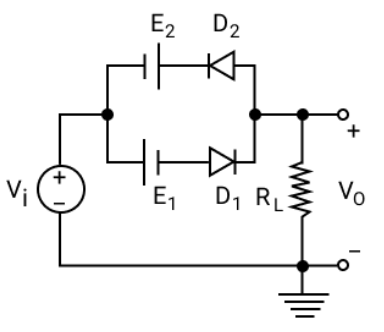
In the given circuit, if the input voltage lies between +E1 and -E2, then output is zero.
Input and output characteristics are shown below.
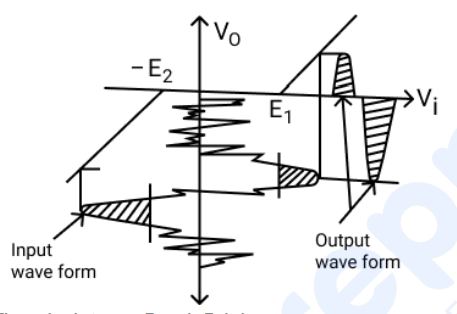
The region between +E1 and -E2 is known as _____.
The minimum number of 2-input NAND gates required to realize the logic function $Y = AB + \bar A \bar B$ is
A*B*A, where * represents XOR, is equal to:


