
Reaction Analysis of $[Cp_2TaMe_2]I$
The reaction involves the Tantalum(V) complex $[Cp_2TaMe_2]I$ and sodium methoxide ($NaOMe$). Here, $Cp$ represents the cyclopentadienyl ligand ($C_5H_5^-$), and $Me$ represents the methyl ligand ($CH_3^-$).
The starting complex is likely ionic: $[{Cp}_2TaMe_2]^+ I^-$. Sodium methoxide ($Na^+ OMe^-$) provides the methoxide anion ($MeO^-$), which is both a base and a nucleophile.
Evaluating Reaction Pathways
- Nucleophilic Substitution: The methoxide ion ($MeO^-$) could potentially substitute a methyl ligand ($Me^-$), yielding $[{Cp}_2Ta(Me)OMe]I$ (Option 2). This pathway is generally less favored compared to alpha-elimination for similar compounds.
- Alpha-Elimination: This is a common reaction mechanism for organometallic alkyl complexes. The methoxide ion ($MeO^-$) acts as a base, abstracting a proton from the alpha-carbon of a methyl group. This facilitates the formation of a metal-carbene double bond ($Ta=CH_2$) and eliminates methanol ($CH_3OH$).
Alpha-Elimination Mechanism Details
The base ($MeO^-$) abstracts an alpha-proton from one of the methyl ligands:
$ [({Cp})_2Ta(CH_3)_2]^+ + CH_3O^- \rightarrow [({Cp})_2Ta(CH_3)(=CH_2)]^+ + CH_3OH $
This process forms the Tantalum carbene complex cation, $[{Cp}_2Ta(Me)(=CH_2)]^+$. The overall product is the salt $[{Cp}_2Ta(Me)(=CH_2)]I$, where $I^-$ is the counterion.
Option 3, ${Cp}_2Ta(Me)=CH_2$, correctly represents the structure of the carbene complex formed. MCQs often simplify notation by omitting charges and counterions to focus on the core chemical transformation.
Conclusion
Alpha-elimination is the predominant reaction pathway under these conditions, leading to the formation of the carbene species represented by Option 3.
Important Questions from Organometallic Chemistry
- The species that undergoes $\beta$-elimination is
The heptacity of allyl and Cp and the ligation mode of NO in the thermodynamically stable complexes
$[(\eta^x-allyl)Ru(CO)_2(NO)]$ and $[(\eta^y-Cp)Ru(CO)_2(NO)]$,
respectively, are
(The heptacity of allyl and Cp are denoted by $\eta^x$ and $\eta^y$, respectively.)The bond angle (Ti-C-C) in the crystal structure of
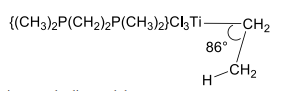
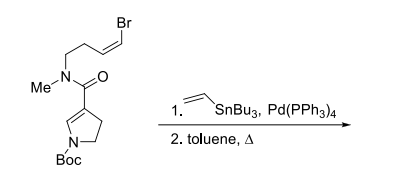
is severely distorted due toThe major product of the following reaction sequence is
Decarbonylation reaction of $[cis-(CH_3CO)Mn(^{13}CO)(CO)_4]$ yields X,Y and Z, where $X =[(CH_3)Mn(CO)_5]$; $Y = [cis-(CH_3)Mn(^{13}CO)(CO)_4]$; $Z = [trans-(CH_3)Mn(^{13}CO)(CO)_4]$
The molar ratio of the products(X : Y : Z) in this reaction is


