
Fe2(CO)9 Structure Analysis
The compound given is Iron carbonyl, with the chemical formula $Fe_2(CO)_9$. This molecule contains two iron (Fe) atoms and a total of nine carbonyl (CO) ligands.
To find the number of terminal carbonyl groups, we first identify the bridging carbonyl groups. A common structural model consistent with the formula and electron counting rules suggests the following arrangement:
- Two iron atoms.
- Three CO ligands acting as bridges ($\mu_2$-CO) between the two Fe atoms.
- The remaining CO ligands are terminal, meaning they are bonded to only one iron atom.
The calculation is as follows:
Number of terminal CO groups = Total CO groups - Number of bridging CO groups
Number of terminal CO groups = $9 - 3 = 6$
This structure features 6 terminal CO ligands and 3 bridging CO ligands. This arrangement is supported by electron counting, suggesting each iron atom achieves a stable electron configuration (approximately 17 valence electrons per Fe atom: 8 core electrons + 3 electrons from terminal COs + 3 electrons from bridging COs = 14 electrons, plus potentially some contribution related to the Fe-Fe interaction or other bonding aspects consistent with 34 total valence electrons).
Therefore, there are 6 terminal carbonyl groups present in $Fe_2(CO)_9$.
Important Questions from Organometallic Chemistry
- The species that undergoes $\beta$-elimination is
The heptacity of allyl and Cp and the ligation mode of NO in the thermodynamically stable complexes
$[(\eta^x-allyl)Ru(CO)_2(NO)]$ and $[(\eta^y-Cp)Ru(CO)_2(NO)]$,
respectively, are
(The heptacity of allyl and Cp are denoted by $\eta^x$ and $\eta^y$, respectively.)The bond angle (Ti-C-C) in the crystal structure of
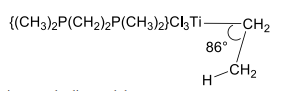
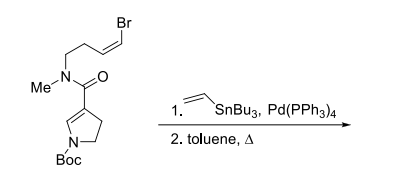
is severely distorted due toThe major product of the following reaction sequence is
Decarbonylation reaction of $[cis-(CH_3CO)Mn(^{13}CO)(CO)_4]$ yields X,Y and Z, where $X =[(CH_3)Mn(CO)_5]$; $Y = [cis-(CH_3)Mn(^{13}CO)(CO)_4]$; $Z = [trans-(CH_3)Mn(^{13}CO)(CO)_4]$
The molar ratio of the products(X : Y : Z) in this reaction is


