
The low lying energy levels due to the vibrational excitations of an even-even nucleus are shown in the figure below. The spin-parity $J^p$ of the level $E_1$ is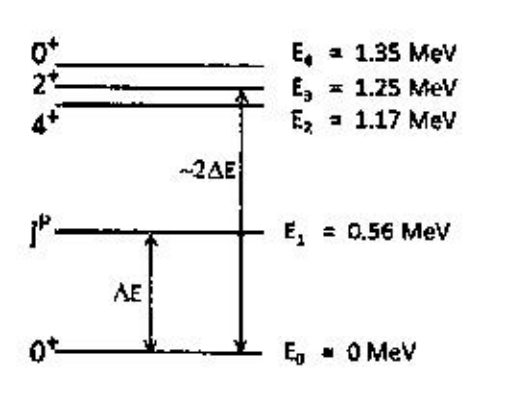
The question asks for the spin-parity $J^p$ of the level $E_1$ based on the energy level diagram provided.
Given the vibrational level scheme for an even-even nucleus, we observe energy levels at:
- $0^+$ at the ground state ($E_0 = 0 \,\text{MeV}$)
- $2^+$ at $E_0$ (indicating it is the first excited state due to quadrupole vibrations)
- $4^+$, $2^+$, and $0^+$ close to each other at higher energies (indicating further collective excitations)
In even-even nuclei, the first excited state is typically the $2^+$ state due to quadrupole vibrations. These states are collectively enhanced, contributing significantly to the energy spectrum.
Therefore, the energy level $E_1 = 0.56 \,\text{MeV}$ corresponds to the first excited state with spin-parity $J^p = 2^+$. Other options such as $1^+$, $1^-$, and $2^-$ do not typically represent the first excited state in such nuclei.
Thus, the correct answer is \(2^+\).
Important Questions from Miscellaneous
- The diatomic molecule HF has an absorption line in the rotational band at $40\text{ cm}^{-1}$ for the isotope $^{18}\text{F}$. The corresponding line for the isotope $^{19}\text{F}$ will be shifted by approximately
A solid spherical cork of radius $R$ and specific gravity $0.5$ floats on water. The cork is pushed down so that its centre of mass is at a distance $h$ (where $0 < h < R$) below the surface of water, and then released. The volume of the part of the cork above water level is $\pi R^3 \left(\frac{2}{3} - \cos\theta_0 + \frac{1}{3}\cos^3\theta_0\right)$, where $\theta_0$ is the angle as shown in the figure.
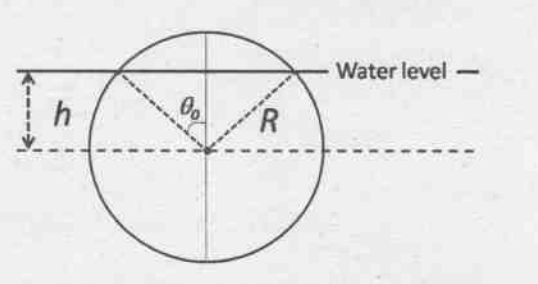
At the moment of release, the dependence of the upward force on the cork on $h$ is
- The energy levels corresponding to the rotational motion of a molecule are $E_J = BJ(J+1)\text{ cm}^{-1}$ where $J = 0,1,2,\dots$ and $B$ is a constant. Pure rotational Raman transitions follow the selection rule $\Delta J = 0, \pm 2$. When the molecule is irradiated, the separation between the closest Stokes and anti-Stokes lines (in cm$^{-1}$) is
- A nucleus decays by the emission of a gamma ray from an excited state of spin-parity $2^+$ to the ground state with spin-parity $0^+$. What is the type of the corresponding radiation?
- In a bacterial cell, a protein is synthesized at random location in the cytoplasm. The protein has to reach one pole of the cell for its appropriate function. The protein reaches the pole by


