
Understanding Rotational Spectroscopy and Isotope Effects
The wavenumber ($\tilde{\nu}$) of rotational absorption lines in diatomic molecules is inversely proportional to the reduced mass ($\mu$) and the moment of inertia ($I$), which depends on the bond length ($r_0$). Specifically, for the $J=0 \to J=1$ transition, $\tilde{\nu} \propto B = \frac{h}{8\pi^2 c I} = \frac{h}{8\pi^2 c \mu r_0^2}$. Thus, $\tilde{\nu} \propto \frac{1}{\mu}$.
Calculating Reduced Masses
The reduced mass $\mu$ for a diatomic molecule AB is given by $\mu = \frac{m_A m_B}{m_A + m_B}$. We assume the mass of Hydrogen ($m_H$) is approximately 1 amu. The masses of the Fluorine isotopes are $m_{18F} \approx 18$ amu and $m_{19F} \approx 19$ amu.
- For $^{18}\text{F}$: $\mu_{18} = \frac{m_H \cdot m_{18F}}{m_H + m_{18F}} = \frac{1 \times 18}{1 + 18} = \frac{18}{19} \text{ amu}$.
- For $^{19}\text{F}$: $\mu_{19} = \frac{m_H \cdot m_{19F}}{m_H + m_{19F}} = \frac{1 \times 19}{1 + 19} = \frac{19}{20} \text{ amu}$.
Determining the Wavenumber Shift
Given that the absorption line for $^{18}\text{F}$ is at $\tilde{\nu}_{18} = 40\text{ cm}^{-1}$. Since $\tilde{\nu} \propto \frac{1}{\mu}$, we have:
$ \frac{\tilde{\nu}_{19}}{\tilde{\nu}_{18}} = \frac{\mu_{18}}{\mu_{19}} $Substitute the values:
$ \frac{\tilde{\nu}_{19}}{40\text{ cm}^{-1}} = \frac{18/19}{19/20} = \frac{18}{19} \times \frac{20}{19} = \frac{360}{361} $Now, calculate $\tilde{\nu}_{19}$:
$ \tilde{\nu}_{19} = 40 \times \frac{360}{361} = 40 \times \left(1 - \frac{1}{361}\right) \approx 40 - \frac{40}{361} \text{ cm}^{-1} $The shift in wavenumber is:
$ \Delta\tilde{\nu} = |\tilde{\nu}_{18} - \tilde{\nu}_{19}| = \left| 40 - \left(40 - \frac{40}{361}\right) \right| = \frac{40}{361} \text{ cm}^{-1} $Calculating the numerical value:
$ \Delta\tilde{\nu} \approx 0.1108 \text{ cm}^{-1} $Therefore, the shift is approximately $0.11\text{ cm}^{-1}$.
Important Questions from Miscellaneous
The low lying energy levels due to the vibrational excitations of an even-even nucleus are shown in the figure below.
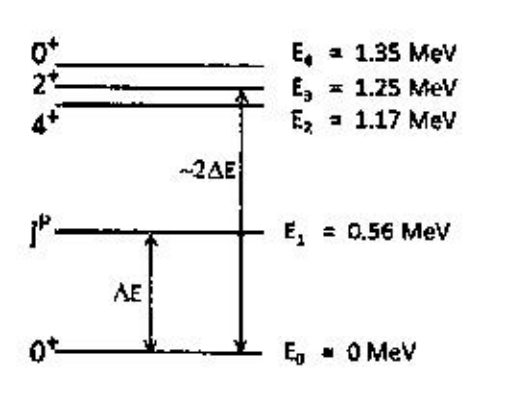
The spin-parity $J^p$ of the level $E_1$ is
A solid spherical cork of radius $R$ and specific gravity $0.5$ floats on water. The cork is pushed down so that its centre of mass is at a distance $h$ (where $0 < h < R$) below the surface of water, and then released. The volume of the part of the cork above water level is $\pi R^3 \left(\frac{2}{3} - \cos\theta_0 + \frac{1}{3}\cos^3\theta_0\right)$, where $\theta_0$ is the angle as shown in the figure.
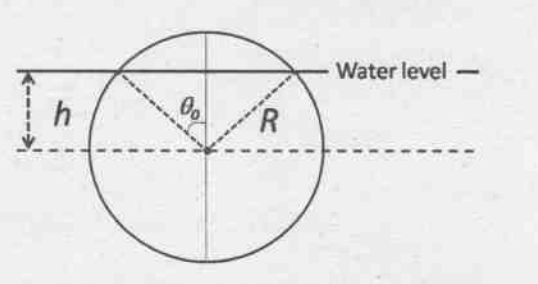
At the moment of release, the dependence of the upward force on the cork on $h$ is
- The energy levels corresponding to the rotational motion of a molecule are $E_J = BJ(J+1)\text{ cm}^{-1}$ where $J = 0,1,2,\dots$ and $B$ is a constant. Pure rotational Raman transitions follow the selection rule $\Delta J = 0, \pm 2$. When the molecule is irradiated, the separation between the closest Stokes and anti-Stokes lines (in cm$^{-1}$) is
- A nucleus decays by the emission of a gamma ray from an excited state of spin-parity $2^+$ to the ground state with spin-parity $0^+$. What is the type of the corresponding radiation?
- In a bacterial cell, a protein is synthesized at random location in the cytoplasm. The protein has to reach one pole of the cell for its appropriate function. The protein reaches the pole by


