
A solid spherical cork of radius $R$ and specific gravity $0.5$ floats on water. The cork is pushed down so that its centre of mass is at a distance $h$ (where $0 < h < R$) below the surface of water, and then released. The volume of the part of the cork above water level is $\pi R^3 \left(\frac{2}{3} - \cos\theta_0 + \frac{1}{3}\cos^3\theta_0\right)$, where $\theta_0$ is the angle as shown in the figure. At the moment of release, the dependence of the upward force on the cork on $h$ is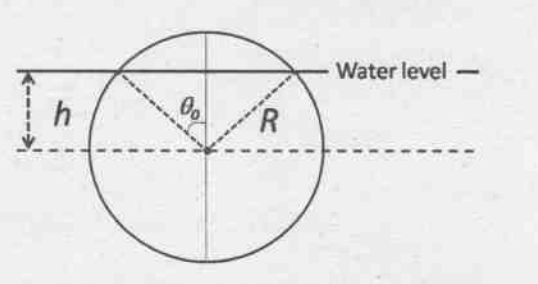
To determine the dependence of the upward force on the cork on \( h \), we can analyze the buoyant force acting on the cork.
The cork has a specific gravity of \( 0.5 \), meaning it is half as dense as water. Therefore, it floats with half of its volume submerged when in equilibrium. The volume submerged when the cork is pushed down is more than half, and it is given by the volume of a segment of a sphere.
The upward buoyant force \( F_b \) is equal to the weight of the displaced water.
The displaced volume of water when the center is at \( h \) is:
\[V = \frac{4}{3} \pi R^3 - \pi R^3 \left(\frac{2}{3} - \cos\theta_0 + \frac{1}{3}\cos^3\theta_0\right)\]The net upward force is the additional buoyant force minus the weight of the submerged cork:
\[F = \rho g \left( V_{submerged} - \frac{1}{2} V_{total} \right)\]The change in submerged volume due to the depression by \( h \) is about the cap-shaped volume:
\[V_{cap} = \pi R^2 \left( R - h \right) - \pi R^2 \cos\theta_0 (R - \frac{1}{3} R \cos^2\theta_0 )\]The restoring force can now be determined approximately, since:
\[F \approx \rho g \cdot \pi R^2 \left( h - \frac{1}{3} \frac{h^3}{R^2} \right)\]Therefore, the dependence of the upward force on \( h \) when expanded is:
\[\frac{h}{R} - \frac{1}{3}\left(\frac{h}{R}\right)^3\]This matches the correct answer option provided.
Illustration showing the floating cork and angles involved.
Important Questions from Miscellaneous
- The diatomic molecule HF has an absorption line in the rotational band at $40\text{ cm}^{-1}$ for the isotope $^{18}\text{F}$. The corresponding line for the isotope $^{19}\text{F}$ will be shifted by approximately
The low lying energy levels due to the vibrational excitations of an even-even nucleus are shown in the figure below.
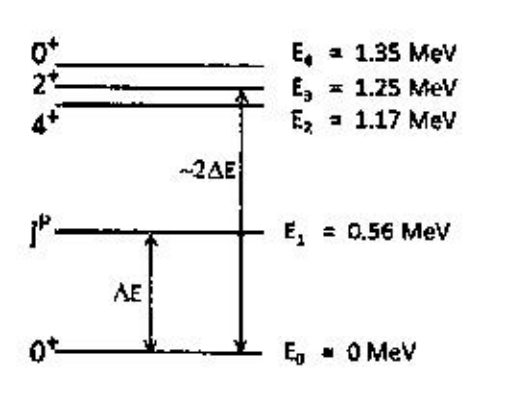
The spin-parity $J^p$ of the level $E_1$ is
- The energy levels corresponding to the rotational motion of a molecule are $E_J = BJ(J+1)\text{ cm}^{-1}$ where $J = 0,1,2,\dots$ and $B$ is a constant. Pure rotational Raman transitions follow the selection rule $\Delta J = 0, \pm 2$. When the molecule is irradiated, the separation between the closest Stokes and anti-Stokes lines (in cm$^{-1}$) is
- A nucleus decays by the emission of a gamma ray from an excited state of spin-parity $2^+$ to the ground state with spin-parity $0^+$. What is the type of the corresponding radiation?
- In a bacterial cell, a protein is synthesized at random location in the cytoplasm. The protein has to reach one pole of the cell for its appropriate function. The protein reaches the pole by


