
Nuclear Decay Radiation Type Analysis
To determine the type of radiation emitted during a gamma decay, we examine the changes in nuclear spin ($J$) and parity ($\pi$) between the initial and final states.
Spin and Parity Change Calculation
- Initial state spin-parity: $J_i = 2$, $\pi_i = +$
- Final state spin-parity: $J_f = 0$, $\pi_f = +$
- Change in angular momentum (spin): $\Delta J = |J_i - J_f| = |2 - 0| = 2$
- Change in parity: $\Delta \pi = \pi_i \times \pi_f = (+) \times (+) = +$ (Parity is conserved)
Determining Radiation Multipolarity
The multipole order ($L$) corresponds to the change in angular momentum, so $L = \Delta J = 2$. This indicates a Quadrupole transition.
We need to determine if it's Electric (E) or Magnetic (M):
- Electric transitions (EL): Parity changes according to $(-1)^L$. For $L=2$, the parity change is $(-1)^2 = +1$. This means parity is conserved.
- Magnetic transitions (ML): Parity changes according to $(-1)^{L+1}$. For $L=2$, the parity change is $(-1)^{2+1} = (-1)^3 = -1$. This means parity is flipped.
Since the parity is conserved in this transition (from $2^+$ to $0^+$), the radiation must be an Electric transition.
Conclusion
With $L=2$ and conserved parity, the transition corresponds to an Electric Quadrupole (E2) radiation.
Important Questions from Miscellaneous
- The diatomic molecule HF has an absorption line in the rotational band at $40\text{ cm}^{-1}$ for the isotope $^{18}\text{F}$. The corresponding line for the isotope $^{19}\text{F}$ will be shifted by approximately
The low lying energy levels due to the vibrational excitations of an even-even nucleus are shown in the figure below.
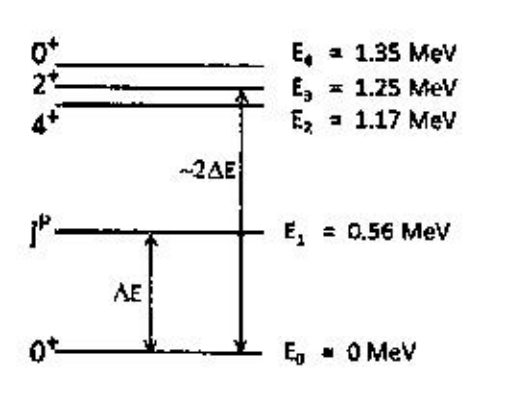
The spin-parity $J^p$ of the level $E_1$ is
A solid spherical cork of radius $R$ and specific gravity $0.5$ floats on water. The cork is pushed down so that its centre of mass is at a distance $h$ (where $0 < h < R$) below the surface of water, and then released. The volume of the part of the cork above water level is $\pi R^3 \left(\frac{2}{3} - \cos\theta_0 + \frac{1}{3}\cos^3\theta_0\right)$, where $\theta_0$ is the angle as shown in the figure.
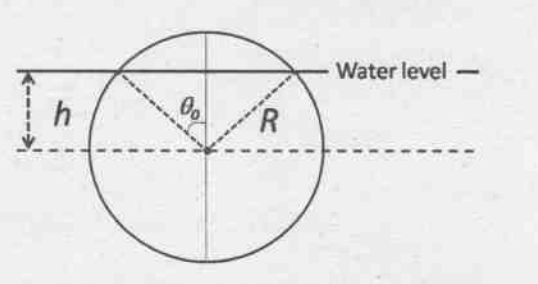
At the moment of release, the dependence of the upward force on the cork on $h$ is
- The energy levels corresponding to the rotational motion of a molecule are $E_J = BJ(J+1)\text{ cm}^{-1}$ where $J = 0,1,2,\dots$ and $B$ is a constant. Pure rotational Raman transitions follow the selection rule $\Delta J = 0, \pm 2$. When the molecule is irradiated, the separation between the closest Stokes and anti-Stokes lines (in cm$^{-1}$) is
- In a bacterial cell, a protein is synthesized at random location in the cytoplasm. The protein has to reach one pole of the cell for its appropriate function. The protein reaches the pole by


