
Bacterial Protein Movement Mechanisms
A protein synthesized randomly within the bacterial cytoplasm needs to reach a specific cell pole. The movement of such molecules within the cellular environment, in the absence of active directed transport systems, primarily occurs through passive processes.
Understanding Protein Movement
- Chemical attraction: This requires a specific chemical gradient or binding site at the pole, which is not universally implied for all proteins.
- Random movement: This refers to the diffusion process, driven by the inherent kinetic energy of molecules. Molecules move from areas of higher concentration to lower concentration, or simply in random directions. Over time, this random motion allows molecules to explore the entire cellular volume, eventually reaching various locations, including a specific pole. This is a fundamental principle governing molecular transport in confined biological spaces like a bacterial cell.
- Enzymatic action: Proteins are products of synthesis; they do not typically use enzymatic action to move themselves unless they are part of a larger machinery (e.g., motor proteins), which is not specified here.
- Attraction between opposite charges: This is a specific form of chemical interaction. While charge interactions can influence molecular localization, it's not the general mechanism for movement from a random point to a pole.
Therefore, the most appropriate and general mechanism for a protein moving from a random synthesis location to a specific pole in a bacterial cell is random movement, akin to diffusion.
Conclusion on Protein Location
The protein reaches the pole primarily through random movement (diffusion) within the cytoplasm.
Important Questions from Miscellaneous
- The diatomic molecule HF has an absorption line in the rotational band at $40\text{ cm}^{-1}$ for the isotope $^{18}\text{F}$. The corresponding line for the isotope $^{19}\text{F}$ will be shifted by approximately
The low lying energy levels due to the vibrational excitations of an even-even nucleus are shown in the figure below.
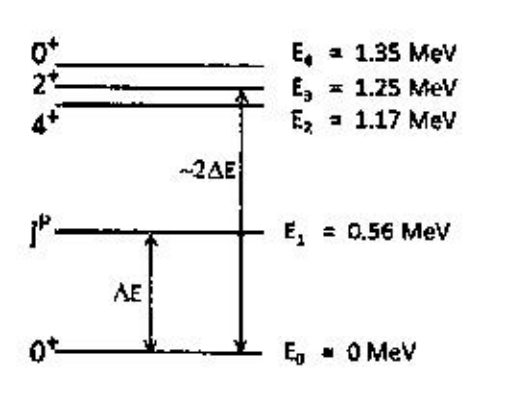
The spin-parity $J^p$ of the level $E_1$ is
A solid spherical cork of radius $R$ and specific gravity $0.5$ floats on water. The cork is pushed down so that its centre of mass is at a distance $h$ (where $0 < h < R$) below the surface of water, and then released. The volume of the part of the cork above water level is $\pi R^3 \left(\frac{2}{3} - \cos\theta_0 + \frac{1}{3}\cos^3\theta_0\right)$, where $\theta_0$ is the angle as shown in the figure.
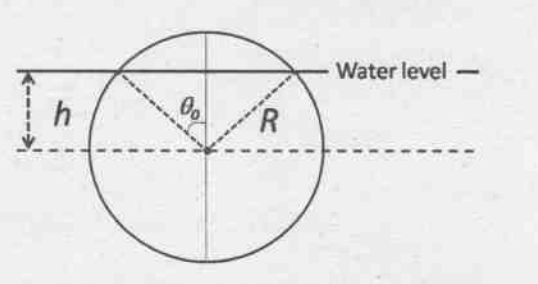
At the moment of release, the dependence of the upward force on the cork on $h$ is
- The energy levels corresponding to the rotational motion of a molecule are $E_J = BJ(J+1)\text{ cm}^{-1}$ where $J = 0,1,2,\dots$ and $B$ is a constant. Pure rotational Raman transitions follow the selection rule $\Delta J = 0, \pm 2$. When the molecule is irradiated, the separation between the closest Stokes and anti-Stokes lines (in cm$^{-1}$) is
- A nucleus decays by the emission of a gamma ray from an excited state of spin-parity $2^+$ to the ground state with spin-parity $0^+$. What is the type of the corresponding radiation?


