
Calculating Internal Energy Change in Ideal Gas Expansion
This solution details the calculation for the change in internal energy ($\Delta U$) of an ideal gas undergoing an expansion process, following the relation $PV^{1.3} = \text{constant}$.
Given Information
- Internal Energy Equation: $U = 3.5 PV + k$
- Initial Volume: $V_1 = 0.25 \, m^3$
- Final Volume: $V_2 = 0.86 \, m^3$
- Initial Pressure: $P_1 = 5 \, N m^{-2}$
- Process Relation: $PV^{1.3} = \text{constant}$
- Constant $k$
Step-by-step Solution
-
Calculate Initial Internal Energy ($U_1$):
Substitute the initial values ($P_1, V_1$) into the internal energy equation:
$U_1 = 3.5 P_1 V_1 + k$
$U_1 = 3.5 \times (5 \, N m^{-2}) \times (0.25 \, m^3) + k$
$U_1 = 3.5 \times 1.25 \, J + k$
$U_1 = 4.375 \, J + k$
-
Calculate Final Pressure ($P_2$):
Using the process relation $P_1 V_1^{1.3} = P_2 V_2^{1.3}$, we find $P_2$:
$P_2 = P_1 \left( \frac{V_1}{V_2} \right)^{1.3}$
$P_2 = 5 \, N m^{-2} \left( \frac{0.25 \, m^3}{0.86 \, m^3} \right)^{1.3}$
$P_2 = 5 \times (0.290697...)^{1.3}$
$P_2 \approx 5 \times 0.19898 \, N m^{-2}$
$P_2 \approx 0.9949 \, N m^{-2}$
-
Calculate Final Internal Energy ($U_2$):
Substitute the final volume ($V_2$) and the calculated final pressure ($P_2$) into the internal energy equation:
$U_2 = 3.5 P_2 V_2 + k$
$U_2 = 3.5 \times (0.9949 \, N m^{-2}) \times (0.86 \, m^3) + k$
$U_2 \approx 3.5 \times 0.8556 \, J + k$
$U_2 \approx 2.9946 \, J + k$
-
Calculate the Change in Internal Energy ($\Delta U$):
Find the difference between the final energy ($U_2$) and the initial energy ($U_1$):
$\Delta U = U_2 - U_1$
$\Delta U = (2.9946 \, J + k) - (4.375 \, J + k)$
$\Delta U \approx 2.9946 \, J - 4.375 \, J$
$\Delta U \approx -1.380 \, J$
The calculated change in internal energy is approximately -1.380 Joules.
Important Questions from First law of thermodynamics
During throttling process:
- The maximum work (|$W_{max}$|, in kJ) that can be obtained by complete combustion of 1.0 mol of $CH_4$ at constant pressure and 25 $^\circ$C is ______ (rounded off to one decimal place).
(Given: $\Delta S = -241.60$ J K$^{-1}$ mol$^{-1}$; $\Delta H = -890.01$ kJ mol$^{-1}$; $R = 8.314$ J mol$^{-1}$ K$^{-1}$) When a gas is compressed suddenly then its temperature
2 mol of a monoatomic ideal gas with initial volume of 5 L and pressure 10 bar undergoes an irreversible adiabatic expansion against a constant final pressure of 1 bar. The final volume (in L) is ________.
(Given: R = $8.314 \times 10^{-2}$ L bar $mol^{-1}$ $K^{-1}$)
(rounded off to one decimal place)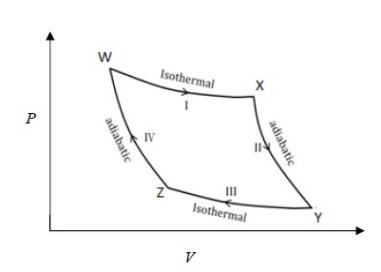
From the above Carnot cycle undergone by an ideal gas, identify the processes in which the change in internal energy is NON-ZERO.


