
The forces acting normally on the cross section of a bar shown in the figure given below introduces ________.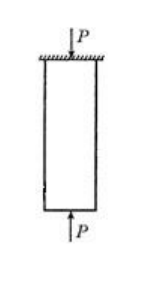
To solve this question, we need to understand the concept of different types of stress that can act on a material. The question involves forces acting normally on the cross-section of a bar.
Types of Stress:
- Compressive Stress: This occurs when forces are applied in a manner that tends to compress or shorten the material.
- Tensile Stress: This occurs when forces are applied in a way that tends to elongate or stretch the material.
- Shear Stress: This occurs when forces are applied parallel or tangentially to the surface, causing one part of a material to slide past another.
Analysis of the Figure:
From the given figure, two forces are acting normally (perpendicular) on the cross-section of the bar. Both forces are directed towards each other, which means they tend to compress the bar.
Conclusion:
The forces are tending to shorten the length of the bar, which is the characteristic of compressive stress. Therefore, the type of stress introduced in the bar is compressive stress.
Justification of Answer:
- The forces act towards each other, compressing the material—characteristic of compressive stress.
- Tensile stress would require forces acting away from each other. This is not the case here.
- Shear stress involves parallel forces, which are not present here.
Therefore, the correct answer is: compressive stress.
Important Questions from Simple Stress and Strain
Linearly elastic, homogeneous, uniform bars BCD and FG shown in the figure have fixed supports at B and G, respectively. For both the bars, axial rigidity is 20000 kN. A gap of 2 mm exists between D and F prior to application of any load (i.e. P = 0). Small deformation and infinitesimal strain assumptions are valid for the given bars.
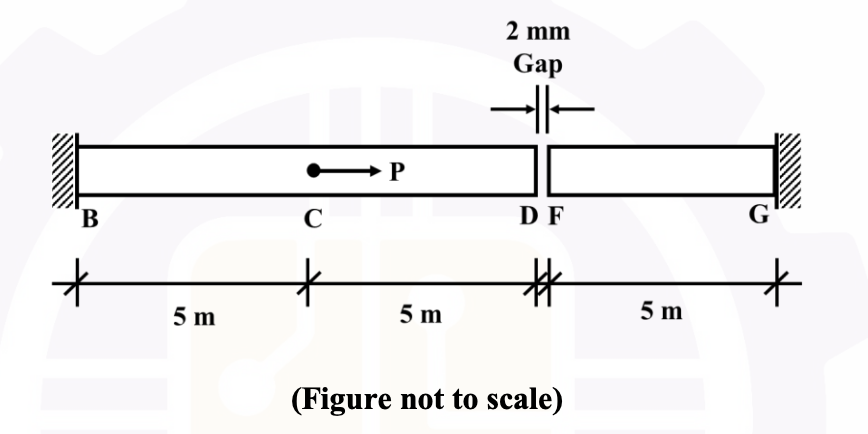
The magnitude of the horizontal reaction (in kN) at B after application of the axial force P of 20 kN at C is ______ (rounded off to the nearest integer).
If a test specimen is stressed slightly beyond the yield point and then unloaded, the yield strength will
A rubber bar of length 1.5 m and 200 mm diameter is stretched along its length by 20 mm by a force of 15 kN. As a result its diameter is reduced by 2 mm. The poisons' ratio of the bar material will be:
The ratio of transverse strain to the longitudinal strain under an axial load is known as
- The standard gauge length over which the extension is to be measured to determine percentage elongation of a specimen with initial cross section ( a c ) is -


