
If a test specimen is stressed slightly beyond the yield point and then unloaded, the yield strength will
increase
Understanding Yield Strength After Stressing Beyond the Yield Point
When a test specimen made of a ductile material, such as steel, is subjected to tensile stress, it initially deforms elastically. This means that if the stress is removed, the specimen returns to its original shape. The limit of this elastic behavior is called the elastic limit or the yield point. Beyond the yield point, the material begins to undergo plastic deformation, where some permanent deformation occurs even after the stress is removed.
What Happens When Stressed Beyond Yield Point and Unloaded?
The question describes a scenario where a specimen is stressed slightly beyond its yield point, entering the plastic deformation region, and then the load is removed (unloaded). Let's consider the stress-strain behavior:
- Initially, the material follows a linear elastic path up to the yield point.
- Beyond the yield point, it deforms plastically.
- When the stress is removed from a point in the plastic region, the material unloads along a path that is approximately parallel to the initial elastic loading path.
- Upon complete unloading, the stress becomes zero, but the strain does not return to zero. There is a permanent plastic strain remaining in the specimen.
The Effect on Yield Strength: Strain Hardening
Now, if this same specimen is reloaded, it will behave elastically again, following the unloading path in reverse, up to the stress level from which it was unloaded previously. It will then yield again at or near that higher stress level. This phenomenon, where plastic deformation causes the material to become harder and stronger (specifically, increases its yield strength), is known as strain hardening or work hardening.
Therefore, stressing a material slightly beyond its yield point and then unloading it effectively increases the stress required to cause subsequent plastic deformation. This means the yield strength of the material has increased.
Let's look at the options:
- decrease: This is incorrect. Plastic deformation generally increases yield strength due to strain hardening.
- increase: This is correct. Strain hardening raises the yield strength.
- remain same: This is incorrect. The material's properties change after plastic deformation.
- becomes equal to ultimate tensile strength: This is incorrect. While yield strength increases, it does not typically reach the ultimate tensile strength just by stressing slightly beyond the initial yield point. The ultimate tensile strength is the maximum stress the material can withstand before necking begins.
Conclusion
When a test specimen is stressed slightly beyond the yield point and then unloaded, the material undergoes plastic deformation and experiences strain hardening. This process results in an increase in the material's yield strength, meaning a higher stress is required to initiate plastic deformation upon subsequent loading.
Important Questions from Simple Stress and Strain
Linearly elastic, homogeneous, uniform bars BCD and FG shown in the figure have fixed supports at B and G, respectively. For both the bars, axial rigidity is 20000 kN. A gap of 2 mm exists between D and F prior to application of any load (i.e. P = 0). Small deformation and infinitesimal strain assumptions are valid for the given bars.
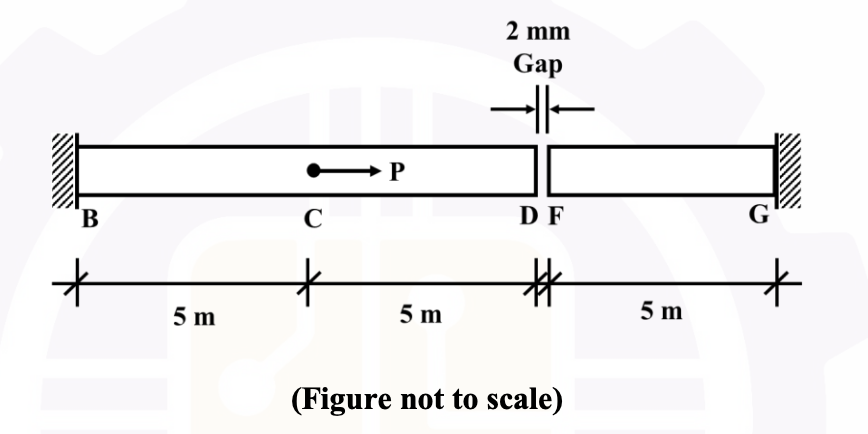
The magnitude of the horizontal reaction (in kN) at B after application of the axial force P of 20 kN at C is ______ (rounded off to the nearest integer).
A rubber bar of length 1.5 m and 200 mm diameter is stretched along its length by 20 mm by a force of 15 kN. As a result its diameter is reduced by 2 mm. The poisons' ratio of the bar material will be:
The ratio of transverse strain to the longitudinal strain under an axial load is known as
- The standard gauge length over which the extension is to be measured to determine percentage elongation of a specimen with initial cross section ( a c ) is -
A thin mild steel wire is loaded by adding loads in equal increments till it breaks. The extensions noted with increasing loads will behave as under:-


