
The ratio of transverse strain to the longitudinal strain under an axial load is known as
Poisson’s ratio
Poisson's Ratio Defined
When an object is subjected to an axial load, it experiences deformation not only in the direction of the load but also perpendicular to it. This phenomenon is a key aspect of material behavior. The ratio quantifying these distinct deformations is a fundamental material property known as Poisson's ratio.
Longitudinal Strain Explained
Longitudinal strain ($\varepsilon_{L}$) refers to the deformation per unit length that occurs in the same direction as the applied axial load. It measures how much a material stretches (if tensile load) or compresses (if compressive load) along the axis where the force is applied.
The formula for longitudinal strain is:
$\varepsilon_{L} = \frac{\Delta L}{L}$
- $\Delta L$ represents the change in the object's length.
- $L$ represents the object's original length.
Transverse Strain Explained
Transverse strain ($\varepsilon_{T}$) is the deformation per unit dimension that occurs perpendicular to the direction of the applied axial load. For instance, when a rod is pulled (stretched longitudinally), its diameter or width typically decreases (transverse contraction). Conversely, when compressed, it tends to bulge out.
The formula for transverse strain is:
$\varepsilon_{T} = \frac{\Delta D}{D}$ (for changes in diameter) or $\frac{\Delta B}{B}$ (for changes in width)
- $\Delta D$ represents the change in diameter.
- $D$ represents the original diameter.
- $\Delta B$ represents the change in width.
- $B$ represents the original width.
Poisson's Ratio Calculation
Poisson's ratio (commonly denoted by $\nu$ or $\mu$) is a dimensionless material property that describes the ratio of transverse strain to longitudinal strain when a material is subjected to an axial load. It essentially quantifies a material's tendency to deform perpendicularly when it is stretched or compressed along its axis.
The mathematical expression for Poisson's ratio is:
$\nu = - \frac{\text{Transverse strain}}{\text{Longitudinal strain}} = - \frac{\varepsilon_{T}}{\varepsilon_{L}}$
The negative sign is included in the definition to ensure that Poisson's ratio is typically a positive value for most materials. This is because a positive longitudinal strain (stretching) usually causes a negative transverse strain (contraction), and vice versa.
- For the majority of engineering materials, Poisson's ratio falls within the range of 0.25 to 0.35.
- Materials that maintain constant volume during elastic deformation, such as natural rubber, have a Poisson's ratio close to 0.5.
- Some unique materials, known as auxetic materials, exhibit a negative Poisson's ratio, meaning they expand transversally when stretched longitudinally.
Modulus Comparisons
It's important to differentiate Poisson's ratio from other material properties related to elasticity:
| Term | Definition and Distinction |
|---|---|
| Tangent modulus of elasticity | This term refers to the slope of the stress-strain curve at a specific point for non-linear elastic materials. It indicates the instantaneous stiffness of the material at that particular stress or strain level, rather than a ratio of strains. |
| Bulk modulus of elasticity | The bulk modulus ($K$ or $B$) measures a material's resistance to volume change under uniform hydrostatic pressure. It is defined as the ratio of hydrostatic stress to volumetric strain. It pertains to overall volume deformation, not the ratio of specific directional strains. |
| Modulus of rigidity | Also known as the shear modulus ($G$ or $\mu$), this property quantifies a material's resistance to shear deformation. It is defined as the ratio of shear stress to shear strain. This involves forces parallel to a surface, causing angular distortion, unlike the axial load considered for Poisson's ratio. |
Based on these definitions, it is clear that the ratio of transverse strain to the longitudinal strain under an axial load is precisely what is known as Poisson's ratio.
Important Questions from Simple Stress and Strain
Linearly elastic, homogeneous, uniform bars BCD and FG shown in the figure have fixed supports at B and G, respectively. For both the bars, axial rigidity is 20000 kN. A gap of 2 mm exists between D and F prior to application of any load (i.e. P = 0). Small deformation and infinitesimal strain assumptions are valid for the given bars.
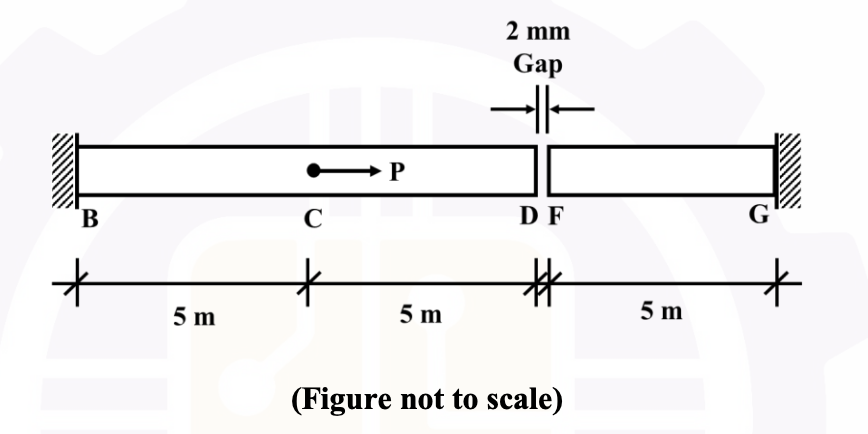
The magnitude of the horizontal reaction (in kN) at B after application of the axial force P of 20 kN at C is ______ (rounded off to the nearest integer).
If a test specimen is stressed slightly beyond the yield point and then unloaded, the yield strength will
A rubber bar of length 1.5 m and 200 mm diameter is stretched along its length by 20 mm by a force of 15 kN. As a result its diameter is reduced by 2 mm. The poisons' ratio of the bar material will be:
- The standard gauge length over which the extension is to be measured to determine percentage elongation of a specimen with initial cross section ( a c ) is -
A thin mild steel wire is loaded by adding loads in equal increments till it breaks. The extensions noted with increasing loads will behave as under:-


