
The standard gauge length over which the extension is to be measured to determine percentage elongation of a specimen with initial cross section ( a c ) is -
Gauge Length for Elongation Measurement
The gauge length is a crucial parameter in tensile testing, a standard mechanical test method used to determine the strength and ductility of materials. It represents the specific length of the specimen over which the elongation is measured during the test. Selecting a standard gauge length ensures consistency and comparability of results across different tests and laboratories.
Percentage Elongation Determination
Percentage elongation is a measure of a material's ductility, indicating how much a material can stretch or deform plastically before fracturing. It is calculated as the ratio of the total increase in gauge length at fracture to the original gauge length, expressed as a percentage.
The formula for percentage elongation is typically:
\[ \text{Percentage Elongation} = \frac{\text{Final Gauge Length} - \text{Original Gauge Length}}{\text{Original Gauge Length}} \times 100\% \]To accurately determine this value, the initial gauge length, often denoted as \(L_0\), must be precisely defined.
Standard Gauge Length and Cross Section
For specimens used in tensile testing, particularly those with a non-circular or varying cross-section, the standard initial gauge length \(L_0\) is often related to the initial cross-sectional area \(a_c\) of the specimen. This proportionality helps to standardize results irrespective of the exact dimensions of the specimen, as long as its cross-sectional area is known.
According to common standards for tensile testing (such as those from ASTM or ISO), the standard gauge length for determining percentage elongation is often given by a formula involving the square root of the initial cross-sectional area. This formula ensures that specimens of different sizes, but similar proportions, behave similarly and yield comparable elongation values.
The widely accepted standard formula relating gauge length to cross-sectional area is:
\[ L_0 = k \sqrt{a_c} \]Where:
- \(L_0\) is the initial gauge length.
- \(a_c\) is the initial cross-sectional area of the specimen.
- \(k\) is a constant specific to the testing standard.
For many international standards, including certain ASTM standards, the value of the constant \(k\) is approximately \(5.65\). Therefore, the standard gauge length \(L_0\) is expressed as:
\[ L_0 = 5.65\sqrt{a_c} \]This relationship ensures that the gauge length scales appropriately with the specimen's cross-section, allowing for consistent and reliable measurements of percentage elongation across a range of specimen sizes. This specific constant is derived from the requirement that the volume of the gauge section remains proportionally constant for different specimen sizes.
Comparing this standard formula with the given options, the one that matches this widely adopted standard is:
\(5.65\sqrt {{a_c}} \)
Important Questions from Simple Stress and Strain
Linearly elastic, homogeneous, uniform bars BCD and FG shown in the figure have fixed supports at B and G, respectively. For both the bars, axial rigidity is 20000 kN. A gap of 2 mm exists between D and F prior to application of any load (i.e. P = 0). Small deformation and infinitesimal strain assumptions are valid for the given bars.
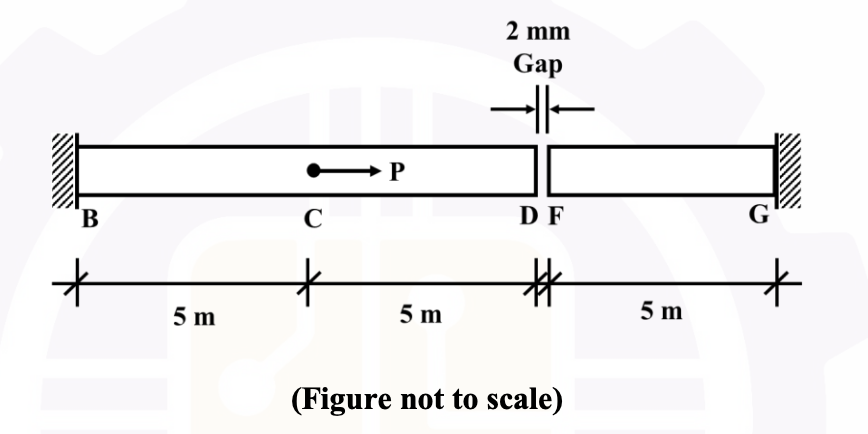
The magnitude of the horizontal reaction (in kN) at B after application of the axial force P of 20 kN at C is ______ (rounded off to the nearest integer).
If a test specimen is stressed slightly beyond the yield point and then unloaded, the yield strength will
A rubber bar of length 1.5 m and 200 mm diameter is stretched along its length by 20 mm by a force of 15 kN. As a result its diameter is reduced by 2 mm. The poisons' ratio of the bar material will be:
The ratio of transverse strain to the longitudinal strain under an axial load is known as
A thin mild steel wire is loaded by adding loads in equal increments till it breaks. The extensions noted with increasing loads will behave as under:-


