
A rubber bar of length 1.5 m and 200 mm diameter is stretched along its length by 20 mm by a force of 15 kN. As a result its diameter is reduced by 2 mm. The poisons' ratio of the bar material will be:
0.75
Poisson's Ratio: Understanding Material Deformation
Poisson's ratio is a fundamental material property that describes how a material deforms perpendicular to the direction of an applied load. When a material is stretched in one direction, it tends to contract in the perpendicular directions. This phenomenon is quantified by Poisson's ratio, which is the negative ratio of the lateral strain to the axial (longitudinal) strain. It is a dimensionless quantity and typically ranges between 0.0 and 0.5 for most engineering materials, though some materials like rubber can have values closer to 0.5 or even higher in specific contexts, or even negative in auxetic materials.
Rubber Bar: Given Data
Let's list the given parameters for the rubber bar:
- Original length of the rubber bar \( (L) \): \( 1.5 \text{ m} = 1500 \text{ mm} \)
- Original diameter of the rubber bar \( (D) \): \( 200 \text{ mm} \)
- Elongation along the length \( (\Delta L) \): \( 20 \text{ mm} \)
- Reduction in diameter \( (\Delta D) \): \( 2 \text{ mm} \)
- Applied force: \( 15 \text{ kN} \) (Note: This value is not needed for calculating Poisson's ratio, as it depends only on strains.)
Axial Strain Calculation
Axial strain \( (\epsilon_L) \) is the change in length divided by the original length. It represents the deformation along the direction of the applied force.
\[ \epsilon_L = \frac{\text{Change in Length}}{\text{Original Length}} = \frac{\Delta L}{L} \]Substituting the given values:
\[ \epsilon_L = \frac{20 \text{ mm}}{1500 \text{ mm}} = \frac{2}{150} = \frac{1}{75} \]Lateral Strain Calculation
Lateral strain \( (\epsilon_D) \) is the change in diameter (or any lateral dimension) divided by the original diameter. Since the diameter reduces, the change is negative.
\[ \epsilon_D = \frac{\text{Change in Diameter}}{\text{Original Diameter}} = \frac{\Delta D}{D} \]Substituting the given values:
\[ \epsilon_D = \frac{-2 \text{ mm}}{200 \text{ mm}} = -\frac{1}{100} \]Poisson's Ratio Determination
Poisson's ratio \( (\nu) \) is defined as the negative ratio of lateral strain to axial strain. The negative sign ensures that Poisson's ratio is a positive value for materials that contract laterally when stretched axially.
\[ \nu = -\frac{\text{Lateral Strain}}{\text{Axial Strain}} = -\frac{\epsilon_D}{\epsilon_L} \]Now, substitute the calculated values of axial and lateral strain:
\[ \nu = -\frac{\left(-\frac{1}{100}\right)}{\left(\frac{1}{75}\right)} \]Simplifying the expression:
\[ \nu = \frac{\frac{1}{100}}{\frac{1}{75}} = \frac{1}{100} \times \frac{75}{1} \] \[ \nu = \frac{75}{100} \] \[ \nu = \frac{3 \times 25}{4 \times 25} \] \[ \nu = \frac{3}{4} = 0.75 \]Therefore, the Poisson's ratio of the rubber bar material is 0.75.
Summary of Calculations
| Parameter | Formula/Value | Calculation |
|---|---|---|
| Original Length \( (L) \) | \( 1500 \text{ mm} \) | Given |
| Original Diameter \( (D) \) | \( 200 \text{ mm} \) | Given |
| Change in Length \( (\Delta L) \) | \( 20 \text{ mm} \) | Given |
| Change in Diameter \( (\Delta D) \) | \( -2 \text{ mm} \) | Given (reduction) |
| Axial Strain \( (\epsilon_L) \) | \( \frac{\Delta L}{L} \) | \( \frac{20}{1500} = \frac{1}{75} \) |
| Lateral Strain \( (\epsilon_D) \) | \( \frac{\Delta D}{D} \) | \( \frac{-2}{200} = -\frac{1}{100} \) |
| Poisson's Ratio \( (\nu) \) | \( -\frac{\epsilon_D}{\epsilon_L} \) | \( -\frac{(-1/100)}{(1/75)} = \frac{75}{100} = 0.75 \) |
Important Questions from Simple Stress and Strain
Linearly elastic, homogeneous, uniform bars BCD and FG shown in the figure have fixed supports at B and G, respectively. For both the bars, axial rigidity is 20000 kN. A gap of 2 mm exists between D and F prior to application of any load (i.e. P = 0). Small deformation and infinitesimal strain assumptions are valid for the given bars.
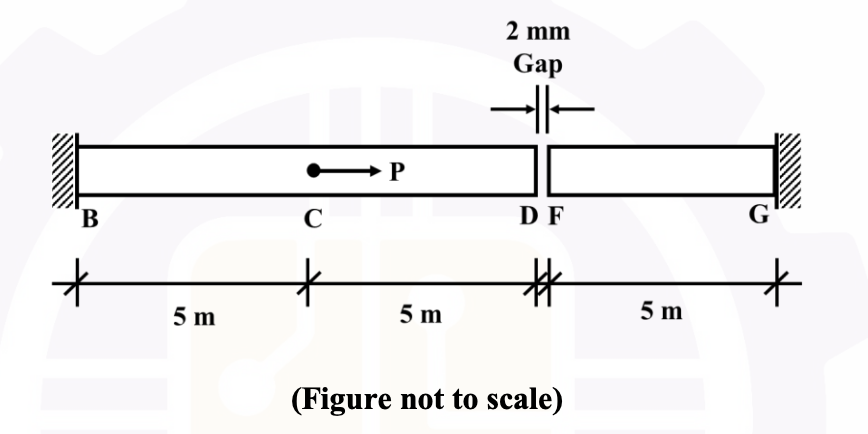
The magnitude of the horizontal reaction (in kN) at B after application of the axial force P of 20 kN at C is ______ (rounded off to the nearest integer).
If a test specimen is stressed slightly beyond the yield point and then unloaded, the yield strength will
The ratio of transverse strain to the longitudinal strain under an axial load is known as
- The standard gauge length over which the extension is to be measured to determine percentage elongation of a specimen with initial cross section ( a c ) is -
A thin mild steel wire is loaded by adding loads in equal increments till it breaks. The extensions noted with increasing loads will behave as under:-


