
Understanding Maximum Force on Current-Carrying Conductor
The force experienced by a current-carrying conductor placed in a magnetic field is governed by the Lorentz force law.
The magnitude of this force ($F$) is given by the formula:
$F = BIL \sin(\theta)$
Where:
- $B$ is the magnetic field strength
- $I$ is the current flowing through the conductor
- $L$ is the length of the conductor within the magnetic field
- $\theta$ is the angle between the direction of the current ($I$) and the direction of the magnetic field ($B$)
To find when the force is maximum, we need to consider the term $\sin(\theta)$ in the formula. The sine function has a maximum value of 1.
- The maximum value of $\sin(\theta)$ is 1, which occurs when $\theta = 90^{\circ}$.
- This means the force ($F$) is maximum when the angle between the current and the magnetic field is $90^{\circ}$.
Therefore, the force on a current-carrying conductor in a magnetic field is maximum when the current is perpendicular to the magnetic field.
Conversely, the force is minimum (zero) when $\sin(\theta) = 0$, which occurs when $\theta = 0^{\circ}$ (current parallel to the field) or $\theta = 180^{\circ}$ (current anti-parallel to the field).
Important Questions from Magnetic Force on a Current-Carrying Wire
- According to Fleming's right-hand rule, if the forefinger indicates the direction of the magnetic field and the thumb shows the direction of motion of the conductor, then the stretched middle finger will predict the direction of
A metallic rod of mass per unit length $0.5 \text{ kg m}^{-1}$ is lying horizontally on a smooth inclined plane which makes an angle of $30^\circ$ with the horizontal. The rod is not allowed to slide down by flowing a current through it when a magnetic field of induction $0.25 \text{ T}$ is acting on it, perpendicular to the inclined plane. The current flowing in the rod to keep it stationary is
A circular coil of radius R having N number of turns carries a steady current I. The magnetic induction at the centre of the coil is 0.1 tesla. If the number of turns is doubled and the radius is halved, which one of the following will be the correct value for the magnetic induction at the centre of the coil?
Consider the following image:
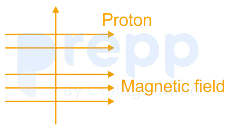
A proton enters a magnetic field at right angles to it, as shown above. The direction of force acting on the proton will be
Consider the following statements about a solenoid:
1. The magnetic field strength in a solenoid depends upon the number of turns per unit length in the solenoid
2. The magnetic field strength in a solenoid depends upon the current flowing in the wire of the solenoid
3. The magnetic field strength in a solenoid depends upon the diameter of the solenoid
Which of the statements given above are correct?


