The figure shows the liquidus phase relations in the forsterite-anorthite-silica system at 1 bar pressure. From the options below, identify the CORRECT reaction that takes place at the isobaric invariant point P.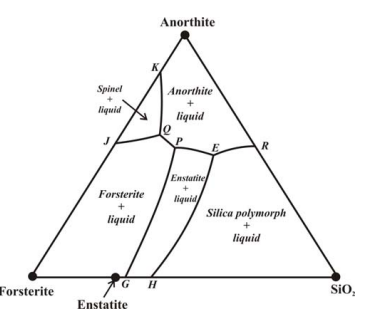
To solve the problem of identifying the correct reaction that takes place at the isobaric invariant point P in the forsterite-anorthite-silica system at 1 bar pressure, we need to consider the nature of invariant points in ternary phase diagrams.
At an invariant point, the phases in equilibrium coexist at a specific temperature and pressure. In the given diagram, point P represents such a condition where a specific reaction takes place.
Let's analyze the options:
- Liquid (at P) = Forsterite + Anorthite + Enstatite: This implies a eutectic reaction, which is unlikely since the presence of a single liquid phase equilibrating with three solid phases typically indicates a peritectic or eutectic reaction leading to two solids, not three.
- Liquid (at P) + Forsterite = Anorthite + Enstatite: This suggests a peritectic reaction where the liquid and one solid phase (forsterite) react to form two solid phases (anorthite and enstatite). This is consistent with common petrologic reactions and matches the conditions at an invariant point.
- Liquid (at P) + Forsterite + Anorthite = Enstatite: This reverse reaction would be uncommon in a typical peritectic system under these pressure conditions.
- Liquid (at P) = Forsterite + Anorthite + Silica polymorph: Similar to the first option, this implies a eutectic reaction, but given typical rock-forming conditions, this setup is less likely under isobaric conditions at point P.
Based on the above analysis, the correct reaction that occurs at the isobaric invariant point P is: Liquid (at P) + Forsterite = Anorthite + Enstatite.
This choice reflects a common peritectic reaction where the combination of a liquid phase and a solid either transforms into or results in two other solid phases, which is consistent with the observed phase relationships in the diagram.
Important Questions from Igneous Petrology (Binary and Ternary Phase Diagrams)
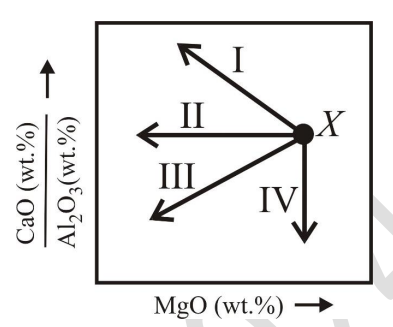
If 'X' represents the initial composition of a melt, which one of the trends indicated by arrows in the schematic diagram corresponds to the evolution of the residual melt composition during crystallization of diopside?
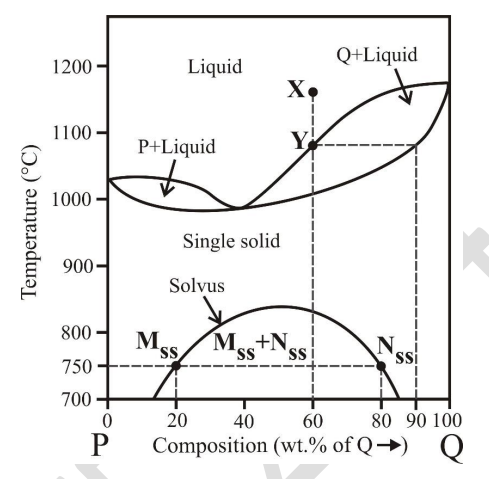
The diagram given below shows phase relations between components P and Q at 1 bar pressure. If ‘X' represents the initial liquid composition, which of the following statements is/are CORRECT during equilibrium crystallization?
- Choose the CORRECT statement regarding crystallization of a single feldspar of composition $Or_{50}Ab_{50}$ in the Albite-Orthoclase system.
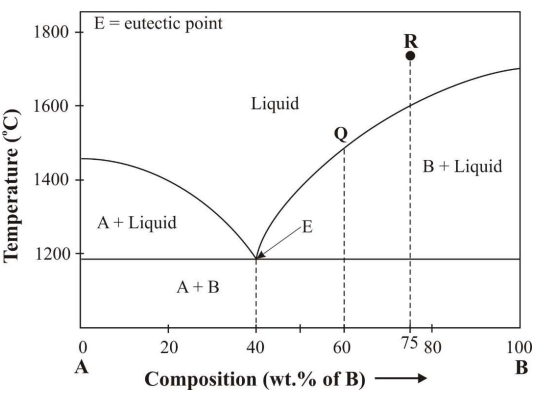
The following diagram shows phase relations in a system consisting of components A and B at 1 bar pressure. If the initial composition of liquid is R, during cooling and crystallization of magma, which of the following statement(s) is/are CORRECT?
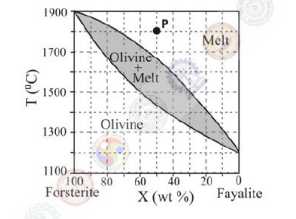
The given T-X diagram shows the phase relations in olivine solid solution at 1 bar pressure. If 'P' is the initial position of melt, the proportion of melt at $1500^\circ$C is __________ %.