
Question
The figure panels below show population growth in two species, when they are grown alone, and also when they are grown together. From the nature of their growth curves, one can infer that the interaction between these species is an example of 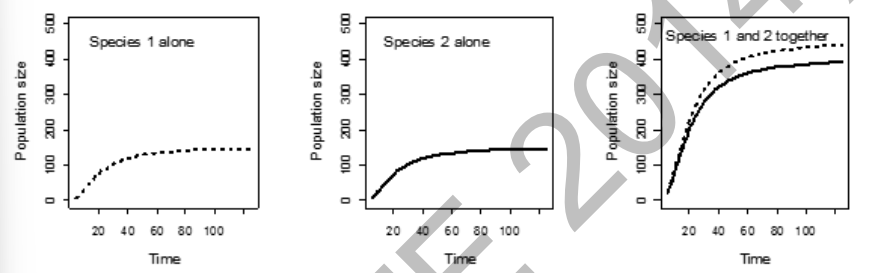
The correct answer is
mutualism
To determine the type of interaction between two species based on their population growth curves, let's analyze the given figure panels:
- The first panel shows the growth curve of Species 1 when grown alone. The curve stabilizes at a certain population size, indicating the carrying capacity of the environment for Species 1 alone.
- The second panel shows the growth curve of Species 2 when grown alone. Similar to Species 1, it stabilizes at its carrying capacity.
- The third panel shows the growth curves of both Species 1 and Species 2 when grown together. Here, the key observation is that both species reach higher population sizes when grown together compared to when grown alone.
From this observation, the growth of both species is enhanced when grown together. This suggests a beneficial interaction between them.
Now, let's evaluate the options:
- Mutualism: This is a type of interaction where both species benefit from each other's presence. The observed increase in population sizes when the species are grown together supports this option.
- Commensalism: In this interaction, one species benefits while the other is neither helped nor harmed. The graphs do not support this, as both species show increased growth.
- Predator-prey: This is characterized by oscillating population sizes and reduced growth due to predation. The graphs do not show such a pattern.
- Competition: This would result in reduced growth for at least one species due to resource competition, which is not supported by the data.
Therefore, based on the enhanced growth of both species when together, the interaction between these species is an example of mutualism.
Correct Answer: mutualism
Was this answer helpful?
Important Questions from Community interactions
- A native species of butterfly at one site in North America used to feed on plant species P. In the 1960s, an exotic plant species Q was introduced at this site. The butterfly switched to feeding on Q, so much so that it was no longer found feeding on P. When the plant species Q was removed from the site in the 1990s, the butterfly species went locally extinct. Later, a population of the same butterfly species from elsewhere, that still fed on plant P, came and occupied the same site. Which one or more of the processes listed below has/have occurred here?
- Which one of the following is a result of antagonistic coevolution?
- Observations of algal species showed that their diversity was higher in pools where there were grazing snails compared to pools without snails. Which one of the following statements best explains this result?
- Which one of the following ecological processes best explains the observation thatseedling establishment increases with distance from the parent tree in a forest?
- Depending on soil nutrient availability, which one or more of the following interaction(s) can occur between soil mycorrhizal fungi and plants?
Need Expert Advice?


