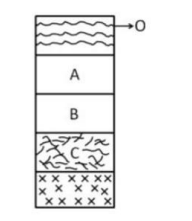
A. Protects underlying weathered material.
B. Prevents infiltration of rainwater to underlying layers
C. Helps in soil formation beneath the calcrete layer.
D. Accelerates chemical weathering beneath the calcrete layer
Calcrete Layer Effects Analysis
A calcrete layer, also known as caliche, is a hardened deposit of calcium carbonate formed in soil or shallow subsurface, typically in arid or semi-arid environments. Understanding its effects is crucial in soil science and geology.
Evaluating the Effects of Calcrete
- A. Protects underlying weathered material: The dense, hardened nature of a calcrete layer acts as a physical barrier. This barrier shields the soil and weathered rock beneath it from surface erosion (like wind and water runoff) and direct weathering processes. Therefore, it protects the underlying material. This statement is correct.
- B. Prevents infiltration of rainwater: Calcrete layers are often relatively impermeable or have low permeability due to their dense structure and calcium carbonate cementation. This characteristic significantly restricts or prevents the downward movement (infiltration) of rainwater into the deeper soil horizons or underlying geological strata. This statement is correct.
- C. Helps in soil formation beneath the layer: Soil formation requires adequate water, air, and nutrient exchange. By limiting water infiltration and potentially aeration, a calcrete layer tends to impede or slow down soil formation processes in the layers beneath it, rather than aiding them. This statement is incorrect.
- D. Accelerates chemical weathering beneath the layer: Chemical weathering is primarily driven by water and chemical reactions. Since the calcrete layer significantly reduces water infiltration (as stated in B), it limits the availability of water needed for chemical weathering processes beneath it. Therefore, it tends to slow down, not accelerate, chemical weathering. This statement is incorrect.
Conclusion
Based on the analysis, statements A and B accurately describe the effects of a calcrete layer. Statements C and D are contrary to the physical and hydrological properties of such a layer.
Therefore, the correct option is the one stating that A and B are correct, while C and D are incorrect.
Important Questions from Formation Of Soil
- A grassland soil that contains dark and thick mineral surface horizon, abundant humus and basic cations, and remains soft after drying is known as:
- Read the following statements and identify the corresponding soil forming processes
I. It is the process of removal of constituents in suspension or solution by percolating water from upper to lower layers.
II. It is the process of deposition of soil material in the lower layers The production of organic acids accelerates leaching in the soil horizon
Read the following statements about clay particles and choose the CORRECT answer
$\text{I}$ : Clay particles are platy. Therefore water tension acts on their large surface area to cause cohesion.
$\text{II}$ : Clay particles have electrically charged surfaces. Charges on the clay attract opposite charges on other particles, holding them together.From which horizon of the given soil profile is the maximum solute flux released?