
To identify which type of soil the question is describing, let's break down the characteristics given:
- The soil is found in grassland regions, which typically have rich soils due to the decomposition of abundant plant matter.
- It contains a dark and thick mineral surface horizon, indicating a high organic matter content.
- The soil is abundant in humus, which is a key component for fertile soil, often leading to a darker color.
- It has a high content of basic cations (such as calcium, magnesium, potassium, and sodium), which help in maintaining soil fertility and structure.
- The soil remains soft after drying, which suggests good soil structure and porosity.
Now, let us consider each of the given options:
- Entisol: These are soils with little to no soil horizon development. They are often found in areas where young soils are forming. This doesn't match our description as these lack the thick humus and mineral horizon.
- Mollisol: Characterized by a thick, dark, organic-rich topsoil horizon (mollic horizon). They are rich in humus and basic cations, making them highly fertile. These are typically found in grassland ecosystems. This matches perfectly with the described soil in the question.
- Alfisol: These soils have a clay-enriched subsoil and good fertility, but they do not typically have the thick, dark surface horizon rich in organic material described in the question.
- Spodosol: Known for a leached, acidic horizon often found under coniferous forests, which doesn't fit our description of fertile grassland soil rich in basic cations and humus.
Given this analysis, the correct type of soil according to the description is Mollisol. Mollisols are known for their agricultural potential due to their high fertility and are predominantly found in grassland regions, making them essential for crops like wheat and corn.
Important Questions from Formation Of Soil
- Read the following statements and identify the corresponding soil forming processes
I. It is the process of removal of constituents in suspension or solution by percolating water from upper to lower layers.
II. It is the process of deposition of soil material in the lower layers The production of organic acids accelerates leaching in the soil horizon
Read the following statements about clay particles and choose the CORRECT answer
$\text{I}$ : Clay particles are platy. Therefore water tension acts on their large surface area to cause cohesion.
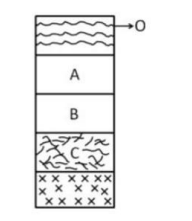
$\text{II}$ : Clay particles have electrically charged surfaces. Charges on the clay attract opposite charges on other particles, holding them together.From which horizon of the given soil profile is the maximum solute flux released?
- Which one of the following is NOT a zonal soil?


