
From which horizon of the given soil profile is the maximum solute flux released?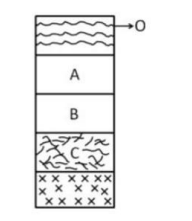
To determine from which horizon in the soil profile the maximum solute flux is released, we need to understand the characteristics of the different soil horizons.
The given soil horizons are:
- \(\text{O}\) Horizon: Organic layer composed mostly of leaf litter and organic matter.
- \(\text{A}\) Horizon: Also known as the topsoil, this layer is rich in organic material mixed with minerals.
- \(\text{B}\) Horizon: Subsoil layers usually denser with accumulating minerals like clay and iron.
- \(\text{C}\) Horizon: Consists mostly of weathered parent material and larger rocks, and is less affected by soil-forming processes.
Explanation: The solute flux in a soil profile generally refers to the movement of dissolved substances, including nutrients and minerals. The horizon where the maximum solute flux occurs usually depends on various factors such as percolation rate, biological activity, and mineral concentration.
The \(\text{C}\) horizon is typically rich in weathered material and might contain various solutes accumulated from leaching and weathering processes above. Since this layer is composed of weathered parent material, it can have a significant release of solutes as minerals continue to break down.
Conclusion: Based on these considerations, the horizon from which the maximum solute flux is released is typically the \(\text{C}\) horizon due to its composition and ongoing weathering activities.
Important Questions from Formation Of Soil
- A grassland soil that contains dark and thick mineral surface horizon, abundant humus and basic cations, and remains soft after drying is known as:
- Read the following statements and identify the corresponding soil forming processes
I. It is the process of removal of constituents in suspension or solution by percolating water from upper to lower layers.
II. It is the process of deposition of soil material in the lower layers The production of organic acids accelerates leaching in the soil horizon
Read the following statements about clay particles and choose the CORRECT answer
$\text{I}$ : Clay particles are platy. Therefore water tension acts on their large surface area to cause cohesion.
$\text{II}$ : Clay particles have electrically charged surfaces. Charges on the clay attract opposite charges on other particles, holding them together.- Which one of the following is NOT a zonal soil?


