
The production of organic acids accelerates leaching in the soil horizon
Understanding Soil Horizon E Leaching
Organic acids are naturally produced during the decomposition of organic matter (in the O and A horizons). These acids can dissolve minerals and aid in transporting organic material downwards.
Role of Organic Acids in Leaching
Leaching is the process where soluble substances are washed out from soil by percolating water. Organic acids enhance this process by:
- Dissolving mineral components.
- Helping to carry away organic matter and metal ions.
Soil Horizons and Leaching Processes
Different soil horizons have distinct characteristics regarding leaching:
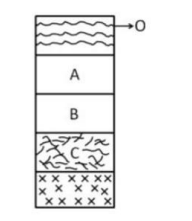
- Horizon O: The surface layer rich in organic matter.
- Horizon A: The topsoil layer, mixed mineral and organic matter. It receives some leached material but is also a source of acids.
- Horizon E: The Eluviation layer. This horizon is characterized by the removal (leaching) of clay, iron, aluminum, organic matter, and other soluble materials, often facilitated by the organic acids descending from the layers above. This acceleration of leaching is most prominent here.
- Horizon B: The Illuviation layer. This layer accumulates materials leached from the E horizon above. Leaching is less pronounced here; accumulation is key.
Therefore, the production of organic acids specifically accelerates the leaching process occurring within the E horizon.
Important Questions from Formation Of Soil
- A grassland soil that contains dark and thick mineral surface horizon, abundant humus and basic cations, and remains soft after drying is known as:
- Read the following statements and identify the corresponding soil forming processes
I. It is the process of removal of constituents in suspension or solution by percolating water from upper to lower layers.
II. It is the process of deposition of soil material in the lower layers Read the following statements about clay particles and choose the CORRECT answer
$\text{I}$ : Clay particles are platy. Therefore water tension acts on their large surface area to cause cohesion.
$\text{II}$ : Clay particles have electrically charged surfaces. Charges on the clay attract opposite charges on other particles, holding them together.From which horizon of the given soil profile is the maximum solute flux released?
- Which one of the following is NOT a zonal soil?


