
Read the following statements about clay particles and choose the CORRECT answer
$\text{I}$ : Clay particles are platy. Therefore water tension acts on their large surface area to cause cohesion.
$\text{II}$ : Clay particles have electrically charged surfaces. Charges on the clay attract opposite charges on other particles, holding them together.
Statement I Analysis: Clay Particles and Cohesion
Statement I posits that clay particles are platy, possess a large surface area, and that water tension acting on this area causes cohesion.
- Platy Structure: Clay particles, primarily composed of sheet silicates like kaolinite and montmorillonite, naturally form flat, plate-like (platy) structures.
- Large Surface Area: Due to their small size and platy shape, clay particles exhibit a very high surface area-to-volume ratio.
- Water Tension and Cohesion: In unsaturated conditions, the curved menisci of water held within the pore spaces between these platy particles create capillary tension. This tension, along with adhesive forces between water and clay surfaces, pulls the particles together, contributing significantly to the soil's apparent cohesion.
Therefore, Statement I is true.
Statement II Analysis: Electrical Charges and Aggregation
Statement II suggests that clay particles have charged surfaces, and these charges attract opposing charges on other particles, leading to aggregation.
- Electrically Charged Surfaces: Clay minerals typically develop negative electrical charges on their surfaces (especially basal planes) due to isomorphic substitution during their formation and weathering. Edges can have variable charges depending on pH.
- Attraction Mechanisms: These surface charges influence the interaction between particles. The negative charges attract positively charged ions (cations) from the surrounding water, forming an electrical double layer. Interactions between these double layers, as well as potential attractions between negatively charged surfaces and positively charged edges (or vice versa), can lead to particle aggregation and flocculation.
- Holding Particles Together: These electrostatic forces are a primary mechanism contributing to the binding and structural integrity of clay aggregates.
Therefore, Statement II is true.
Conclusion on Statements
Both Statement I and Statement II accurately describe key properties and interaction mechanisms of clay particles related to cohesion and aggregation.
Final Answer: The final answer is D
Important Questions from Formation Of Soil
- A grassland soil that contains dark and thick mineral surface horizon, abundant humus and basic cations, and remains soft after drying is known as:
- Read the following statements and identify the corresponding soil forming processes
I. It is the process of removal of constituents in suspension or solution by percolating water from upper to lower layers.
II. It is the process of deposition of soil material in the lower layers The production of organic acids accelerates leaching in the soil horizon
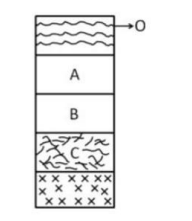
From which horizon of the given soil profile is the maximum solute flux released?
- Which one of the following is NOT a zonal soil?


