The displacement of a plane progressive wave in a medium, travelling towards positive x-axis with velocity 4 m/s at t = 0 is given by \(y = 3\sin 2\pi\left(-\dfrac{x}{3}\right)\). Then the expression for the displacement at a later time t = 4 sec will be
\(y = 3\sin 2\pi\left(-\dfrac{x-16}{3}\right)\)
A wave travelling along the positive x-direction with speed v keeps its shape and simply shifts forward, so its displacement is a function of \(x - vt\). The profile at any later time is obtained by replacing x with \(x - vt\) in the profile at t = 0.
Step 1 — At t = 0 the profile is \(y = 3\sin 2\pi\left(-\dfrac{x}{3}\right)\) and the speed is \(v = 4\ \text{m s}^{-1}\).
Step 2 — General form: \(y(x,t) = 3\sin 2\pi\left(-\dfrac{x - vt}{3}\right)\).
Step 3 — At t = 4 s the shift is \(vt = 4 \times 4 = 16\ \text{m}\), giving \(y = 3\sin 2\pi\left(-\dfrac{x-16}{3}\right)\).
The expression with \(\dfrac{-x-16}{3}\) depends on \(x + 16\), i.e. a profile shifted 16 m towards the negative x-axis. The expressions with \(\dfrac{-x+1}{3}\) and \(\dfrac{-x-1}{3}\) correspond to a shift of only 1 m, which is not the distance covered in 4 s at 4 m/s.
\(y = 3\sin 2\pi\left(-\dfrac{x-16}{3}\right)\) option is correct.
Similar Questions
- The equation of a transverse wave is $y = y_0 \sin 2\pi(ft - \frac{x}{\lambda})$. If the maximum particle velocity be four times that of wave velocity then
In a simple harmonic motion, let f be the acceleration and T be the time period. If x denotes the displacement, then |f T| vs. x graph will look like,
A wave disturbance in a medium is described by \(y(x,t)=0.02\cos\left(50\pi t+\dfrac{\pi}{2}\right)\cos(10\pi x)\) where x, y are in meters and t is in second. Which statement(s) is/are correct?
The equation of a stationary wave along a stretched string is given by
\(y=5\sin\dfrac{\pi x}{3}\cos 40\pi t\).
Here x and y are in cm and t in second. The separation between two adjacent nodes is
The variation of displacement with time of a simple harmonic motion (SHM) for a particle of mass m is represented by \(y=2\sin\left(\dfrac{\pi t}{2}+\phi\right)\) cm. The maximum acceleration of the particle is
If the pressure, temperature and density of an ideal gas are denoted by \(P\), \(T\) and \(\rho\), respectively, the velocity of sound in the gas is
A unit negative charge with mass \(M\) resides at the midpoint of the straight line of length \(2a\) adjoining two fixed charges of magnitude \(+Q\) each. If it is given a very small displacement \(x(x\ll a)\) in a direction perpendicular to the straight line, it will
A uniform string of length \(L\) and mass \(M\) is fixed at both ends while it is subject to a tension \(T\). It can vibrate at frequencies (\(\nu\)) given by the formula (where \(n = 1, 2, 3, \ldots\))
The velocity of a particle executing a simple harmonic motion is \(13\ \mathrm{ms^{-1}}\), when its distance from the equilibrium position (Q) is 3 m and its velocity is \(12\ \mathrm{ms^{-1}}\), when it is 5 m away from Q. The frequency of the simple harmonic motion is
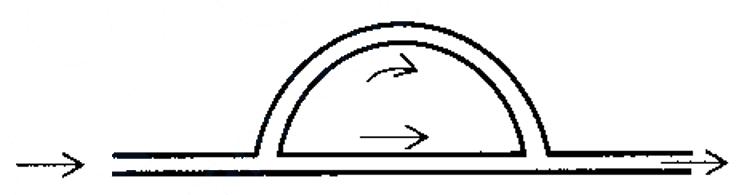
Sound waves are passing through two routes- one in straight path and the other along a semicircular path of radius \(r\), and are again combined into one pipe and superposed as shown in the figure. If the velocity of sound waves in the pipe is \(v\), then frequencies of resultant waves of maximum amplitude will be integral multiples of
Important Questions from Oscillations and Waves
- Two tuning forks $A$ and $B$ are sounded together giving rise to $8$ beats in $2\text{ s}$. When fork $A$ is loaded with wax, the beat frequency is reduced to $4$ beats in $2\text{ s}$. If the original frequency of tuning fork $B$ is $380\text{ Hz}$ then original frequency of tuning fork $A$ is _________ $\text{Hz}$.
- 5 beats/second are heard when a turning fork is sounded with a sonometer wire under tension, when the length of the sonometer wire is either 0.95 m or 1 m. The frequency of the fork will be
- A sinusoidal wave of wavelength 7.5 cm travels a distance of 1.2 cm along the x-direction in 0.3 sec. The crest P is at x=0 at t=0 sec and maximum displacement of the wave is 2 cm. Which equation correctly represents this wave ?
A particle is subjected to two simple harmonic motions as :
$x_1 = \sqrt{7} \sin 5t \text{ cm}$ and $x_2 = 2\sqrt{7} \sin \left(5t + \frac{\pi}{3}\right) \text{ cm}$
where x is displacement and t is time in seconds. The maximum acceleration of the particle is $x \times 10^{-2} \text{ ms}^{-2}$. The value of x is :- Two harmonic waves moving in the same direction superimpose to form awave $x = a \cos (1.5t) \cos (50.5t)$ where $t$ is in seconds. Find the period with which they beat.(close to nearest integer)