Problem Analysis:
- The question concerns a wheel rolling without slipping on a plane surface.
- The velocity of the wheel's center is given as $v_0$.
- We need to find the speed of a particle on the rim located at the same vertical level as the center.
- The final speed is expressed as $\sqrt{x} v_0$, and we need to find the value of $x$.
Understanding Rolling Motion Velocities
For a wheel rolling without slipping:
- The velocity of the center ($\vec{v}_c$) is related to the angular velocity ($\omega$) and radius ($R$) by $v_0 = \omega R$.
- The velocity of any point on the rim ($\vec{v}_p$) relative to the ground is the vector sum of the center's velocity ($\vec{v}_c$) and the point's velocity relative to the center ($\vec{v}_{rel}$). That is, $\vec{v}_p = \vec{v}_c + \vec{v}_{rel}$.
- The magnitude of the velocity relative to the center is $|\vec{v}_{rel}| = \omega R = v_0$. This velocity is always tangential to the rim.
Determining Particle Velocity
- Define Coordinate System: Let the wheel move along the positive x-axis. The center's velocity is $\vec{v}_c = v_0 \hat{i}$. Assume clockwise rotation for forward motion, meaning the angular velocity vector is $\vec{\omega} = -\omega \hat{k}$.
- Locate the Particle: A particle "at the same level as the centre" means its vertical position is the same as the center's. In a standard coordinate system where the center is at height $R$, this corresponds to points on the rim where the angle $\theta$ (measured from the positive x-axis) satisfies $R \sin\theta = 0$. This occurs when $\theta = 0$ (point horizontally aligned and ahead of the center) or $\theta = \pi$ (point horizontally aligned and behind the center).
- Calculate Relative Velocity ($\vec{v}_{rel}$):
- For $\theta = 0$ (point ahead): The position vector from the center is $\vec{r} = R \hat{i}$. The relative velocity is $\vec{v}_{rel} = \vec{\omega} \times \vec{r} = (-\omega \hat{k}) \times (R \hat{i}) = -\omega R \hat{j} = -v_0 \hat{j}$.
- For $\theta = \pi$ (point behind): The position vector from the center is $\vec{r} = -R \hat{i}$. The relative velocity is $\vec{v}_{rel} = \vec{\omega} \times \vec{r} = (-\omega \hat{k}) \times (-R \hat{i}) = \omega R \hat{j} = v_0 \hat{j}$.
- Calculate Particle Velocity ($\vec{v}_p$): $\vec{v}_p = \vec{v}_c + \vec{v}_{rel}$.
- For $\theta = 0$: $\vec{v}_p = v_0 \hat{i} + (-v_0 \hat{j}) = v_0 \hat{i} - v_0 \hat{j}$.
- For $\theta = \pi$: $\vec{v}_p = v_0 \hat{i} + v_0 \hat{j}$.
- Calculate Speed: The speed is the magnitude of $\vec{v}_p$.
- For $\theta = 0$: Speed $= |\vec{v}_p| = \sqrt{(v_0)^2 + (-v_0)^2} = \sqrt{v_0^2 + v_0^2} = \sqrt{2v_0^2} = \sqrt{2} v_0$.
- For $\theta = \pi$: Speed $= |\vec{v}_p| = \sqrt{(v_0)^2 + (v_0)^2} = \sqrt{v_0^2 + v_0^2} = \sqrt{2v_0^2} = \sqrt{2} v_0$.
Finding the Value of x
The calculated speed is $\sqrt{2} v_0$. We are given that the speed is $\sqrt{x} v_0$. Equating these:
$ \sqrt{x} v_0 = \sqrt{2} v_0 $
Dividing both sides by $v_0$ (assuming $v_0 \neq 0$):
$ \sqrt{x} = \sqrt{2} $
Squaring both sides gives:
$ x = 2 $
Similar Questions
- A soap bubble of surface tension $0.04 \text{ N/m}$ is blown to a diameter of $7 \text{ cm}$. If $(15000 - x) \text{ }\mu\text{J}$ of work is done in blowing it further to make its diameter $14 \text{ cm}$, then the value of $x$ is _______.
($\pi = 22/7$) - A uniform solid cylinder of length $L$ and radius $R$ has moment of inertia about its axis equal to $I_1$. A small co-centric cylinder of length $L/2$ and radius $R/3$ carved from this cylinder has moment of inertia about its axis equals to $I_2$. The ratio $I_1/I_2$ is _______.
- A fly wheel having mass $3\text{ kg}$ and radius $5\text{ m}$ is free to rotate about a horizontal axis. A string having negligible mass is wound around the wheel and the loose end of the string is connected to $3\text{ kg}$ mass. The mass is kept at rest initially and released. Kinetic energy of the wheel when the mass descends by $3\text{ m}$ is _________ $\text{J}$. ($g = 10\text{ m/s}^{2}$)
A fly wheel of mass $10$ kg and radius $50$ cm is rotating at a rate of$360$ rpm. Assuming mass to be concentrated at the rim, the constant retarding torque required to stop the rotation of wheel in $6$ rotations will be x Nm. The value of x is ____________.
A body moving horizontally on a smooth surface with a speed of $20$ $ms^{-1}$ splits into two parts and continue to move in the same direction. The masses of two parts are in the ratio of $1:2$. The smaller part moves with a speed of $30$ $ms^{-1}$. The fractional change is the kinetic energy is given by $\frac{1}{x}$. The value of x is__________
- A disc rotates about its axis of symmetry in a horizontal plane at a steady rate of 3.5 revolutions per second. A coin placed at a distance of 1.25 cm from the axis of rotation remains at rest on the disc. The coefficient of friction between the coin and the disc is: (g = 10 m/s²)
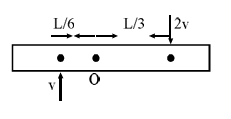
A thin uniform bar of length L and mass 8 m lies on a smooth horizontal table. Two point masses m and 2 m are moving in the same horizontal plane from opposite sides of the bar with speeds 2v and v respectively. The masses stick to the bar after collision at a distance $\frac{L}{3}$ and $\frac{L}{6}$ respectively from the centre of the bar. If the bar starts rotating about its center of mass as a result of collision, the angular speed of the bar will be :
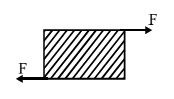
As shown in the figure, forces of $10^5$ N each are applied in opposite directions, on the upper and lower faces of a cube of side 10 cm, shifting the upper face parallel to itself by 0.5 cm. If the side of another cube of the same material is 20 cm, then under similar conditions as above, the displacement will be :
Three identical spheres of mass m, are placed at the vertices of an equilateral triangle of length a. When released, they interact only through gravitational force and collide after a time T = 4 seconds. If the sides of the triangle are increased to length 2a and also the masses of the spheres are made 2m, then they will collide after __________ seconds.
A 4.0 cm long straight wire carrying a current of 8A is placed perpendicular to a uniform magnetic field of strength 0.15 T. The magnetic force on the wire is __________ mN.
Important Questions from Mechanics
- A soap bubble of surface tension $0.04 \text{ N/m}$ is blown to a diameter of $7 \text{ cm}$. If $(15000 - x) \text{ }\mu\text{J}$ of work is done in blowing it further to make its diameter $14 \text{ cm}$, then the value of $x$ is _______.
($\pi = 22/7$) - A uniform solid cylinder of length $L$ and radius $R$ has moment of inertia about its axis equal to $I_1$. A small co-centric cylinder of length $L/2$ and radius $R/3$ carved from this cylinder has moment of inertia about its axis equals to $I_2$. The ratio $I_1/I_2$ is _______.
- A fly wheel having mass $3\text{ kg}$ and radius $5\text{ m}$ is free to rotate about a horizontal axis. A string having negligible mass is wound around the wheel and the loose end of the string is connected to $3\text{ kg}$ mass. The mass is kept at rest initially and released. Kinetic energy of the wheel when the mass descends by $3\text{ m}$ is _________ $\text{J}$. ($g = 10\text{ m/s}^{2}$)
- A body of density '$\rho$' is dropped slowly on the surface of a lake of depth $d$. If the density of the lake water be '$\rho'$' ($\rho' < \rho$) then the time taken by the body to reach the bottom of the lake is
Three blocks of masses $m_1 = 2\text{ kg}$, $m_2 = 3\text{ kg}$ and $m_3 = 5\text{ kg}$ are placed on a horizontal frictionless surface and a force of 30N pulls the system as shown below. The value of tension in the string between $m_2$ and $m_3$ will be