
A thin uniform bar of length L and mass 8 m lies on a smooth horizontal table. Two point masses m and 2 m are moving in the same horizontal plane from opposite sides of the bar with speeds 2v and v respectively. The masses stick to the bar after collision at a distance $\frac{L}{3}$ and $\frac{L}{6}$ respectively from the centre of the bar. If the bar starts rotating about its center of mass as a result of collision, the angular speed of the bar will be :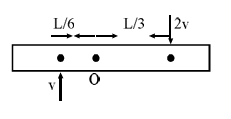
To find the angular speed of the bar after collision, we need to consider the conservation of linear momentum and angular momentum.
- First, calculate the initial linear momentum of the system:
- The momentum of mass \(m\) moving with speed \(2v\) is \(m \cdot 2v = 2mv\).
- The momentum of mass \(2m\) moving with speed \(v\) is \(2m \cdot v = 2mv\).
- Calculate the positions of these masses relative to the center of the bar:
- Mass \(m\) is at a distance \(\frac{L}{3}\).
- Mass \(2m\) is at a distance \(\frac{L}{6}\).
- Calculate the moment of inertia of the system after collision:
- The moment of inertia of the bar about its center is \(\frac{1}{12}ML^2\), where \(M = 8m\).
- The moment of inertia contributed by mass \(m\) is \(m \left(\frac{L}{3}\right)^2 = \frac{mL^2}{9}\).
- The moment of inertia contributed by mass \(2m\) is \(2m\left(\frac{L}{6}\right)^2 = \frac{mL^2}{18}\).
- Using conservation of angular momentum:
- Initial angular momentum = \(m \cdot 2v \cdot \frac{L}{3} + 2m \cdot v \cdot \frac{L}{6}\)
- Simplify to get \(\frac{4mvL}{3}\).
- Using conservation: \(I \cdot \omega = \frac{4mvL}{3}\)
- Solving for angular speed, \(\omega\):
- \(\omega = \frac{4mvL/3}{I} = \frac{6v}{5L}\).
The correct option is \(\frac{6v}{5L}\).
Similar Questions
- A soap bubble of surface tension $0.04 \text{ N/m}$ is blown to a diameter of $7 \text{ cm}$. If $(15000 - x) \text{ }\mu\text{J}$ of work is done in blowing it further to make its diameter $14 \text{ cm}$, then the value of $x$ is _______.
($\pi = 22/7$) - A uniform solid cylinder of length $L$ and radius $R$ has moment of inertia about its axis equal to $I_1$. A small co-centric cylinder of length $L/2$ and radius $R/3$ carved from this cylinder has moment of inertia about its axis equals to $I_2$. The ratio $I_1/I_2$ is _______.
- A fly wheel having mass $3\text{ kg}$ and radius $5\text{ m}$ is free to rotate about a horizontal axis. A string having negligible mass is wound around the wheel and the loose end of the string is connected to $3\text{ kg}$ mass. The mass is kept at rest initially and released. Kinetic energy of the wheel when the mass descends by $3\text{ m}$ is _________ $\text{J}$. ($g = 10\text{ m/s}^{2}$)
A fly wheel of mass $10$ kg and radius $50$ cm is rotating at a rate of$360$ rpm. Assuming mass to be concentrated at the rim, the constant retarding torque required to stop the rotation of wheel in $6$ rotations will be x Nm. The value of x is ____________.
A body moving horizontally on a smooth surface with a speed of $20$ $ms^{-1}$ splits into two parts and continue to move in the same direction. The masses of two parts are in the ratio of $1:2$. The smaller part moves with a speed of $30$ $ms^{-1}$. The fractional change is the kinetic energy is given by $\frac{1}{x}$. The value of x is__________
- A disc rotates about its axis of symmetry in a horizontal plane at a steady rate of 3.5 revolutions per second. A coin placed at a distance of 1.25 cm from the axis of rotation remains at rest on the disc. The coefficient of friction between the coin and the disc is: (g = 10 m/s²)
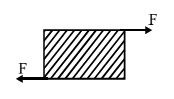
As shown in the figure, forces of $10^5$ N each are applied in opposite directions, on the upper and lower faces of a cube of side 10 cm, shifting the upper face parallel to itself by 0.5 cm. If the side of another cube of the same material is 20 cm, then under similar conditions as above, the displacement will be :
- The excess pressure inside a soap bubble A in air is half the excess pressure inside another soap bubble B in air. If the volume of the bubble A is n times the volume of the bubble B, then, the value of n is __________
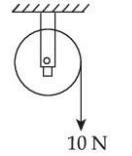
A wheel of radius 0.2 m rotates freely about its center when a string that is wrapped over its rim is pulled by force of 10 N as shown in figure. The established torque produces an angular acceleration of 2 rad/s². Moment of intertia of the wheel is ________ kg m².
(Acceleration due to gravity = 10 m/s²)A satellite of mass 1000 kg is launched to revolve around the earth in an orbit at a height of 270 km from the earth's surface. Kinetic energy of the satellite in this orbit is ________ $\times 10^{10}$ J.
(Mass of earth = $6\times10^{24}$ kg, Radius of earth = $6.4\times10^6$ m, Gravitational constant = $6.67 \times 10^{-11}$ $Nm^2kg^{-2}$)
Important Questions from Mechanics
- A soap bubble of surface tension $0.04 \text{ N/m}$ is blown to a diameter of $7 \text{ cm}$. If $(15000 - x) \text{ }\mu\text{J}$ of work is done in blowing it further to make its diameter $14 \text{ cm}$, then the value of $x$ is _______.
($\pi = 22/7$) - A uniform solid cylinder of length $L$ and radius $R$ has moment of inertia about its axis equal to $I_1$. A small co-centric cylinder of length $L/2$ and radius $R/3$ carved from this cylinder has moment of inertia about its axis equals to $I_2$. The ratio $I_1/I_2$ is _______.
- A fly wheel having mass $3\text{ kg}$ and radius $5\text{ m}$ is free to rotate about a horizontal axis. A string having negligible mass is wound around the wheel and the loose end of the string is connected to $3\text{ kg}$ mass. The mass is kept at rest initially and released. Kinetic energy of the wheel when the mass descends by $3\text{ m}$ is _________ $\text{J}$. ($g = 10\text{ m/s}^{2}$)
A fly wheel of mass $10$ kg and radius $50$ cm is rotating at a rate of$360$ rpm. Assuming mass to be concentrated at the rim, the constant retarding torque required to stop the rotation of wheel in $6$ rotations will be x Nm. The value of x is ____________.
A body moving horizontally on a smooth surface with a speed of $20$ $ms^{-1}$ splits into two parts and continue to move in the same direction. The masses of two parts are in the ratio of $1:2$. The smaller part moves with a speed of $30$ $ms^{-1}$. The fractional change is the kinetic energy is given by $\frac{1}{x}$. The value of x is__________


