
Three identical spheres of mass m, are placed at the vertices of an equilateral triangle of length a. When released, they interact only through gravitational force and collide after a time T = 4 seconds. If the sides of the triangle are increased to length 2a and also the masses of the spheres are made 2m, then they will collide after __________ seconds.
Gravitational Force Physics Explanation
This problem involves three identical spheres interacting solely through gravity. They are initially placed at the vertices of an equilateral triangle and start moving towards each other due to gravitational attraction. We need to find how the collision time changes when both the initial separation distance and the masses of the spheres are altered.
Collision Time Proportionality
The time it takes for such a system to collapse under its own gravity can be shown to be proportional to the initial side length raised to the power of 3/2, and inversely proportional to the square root of the mass of the individual spheres. Mathematically, the collision time T follows the relation:
$T \propto \frac{a^{3/2}}{\sqrt{m}}$
Where:
- $T$ is the collision time.
- $a$ is the initial side length of the equilateral triangle.
- $m$ is the mass of each identical sphere.
Initial Collision Time Calculation
Let the initial collision time be $T_1$, initial side length be $a_1$, and initial mass be $m_1$. We are given:
- $T_1 = 4$ seconds
- $a_1 = a$
- $m_1 = m$
Using the proportionality:
$T_1 \propto \frac{a_1^{3/2}}{\sqrt{m_1}} \implies 4 \propto \frac{a^{3/2}}{\sqrt{m}}$
New Collision Time Calculation
Let the new collision time be $T_2$, new side length be $a_2$, and new mass be $m_2$. We are given:
- $a_2 = 2a$
- $m_2 = 2m$
Using the same proportionality for the new conditions:
$T_2 \propto \frac{a_2^{3/2}}{\sqrt{m_2}}$
Substitute the new values:
$T_2 \propto \frac{(2a)^{3/2}}{\sqrt{2m}}$
Simplify the expression:
$T_2 \propto \frac{2^{3/2} a^{3/2}}{\sqrt{2} \sqrt{m}} = \frac{2 \sqrt{2} a^{3/2}}{\sqrt{2} \sqrt{m}} = \frac{2 a^{3/2}}{\sqrt{m}}$
Collision Time Ratio
Now, we can find the ratio of the new collision time ($T_2$) to the initial collision time ($T_1$):
$\frac{T_2}{T_1} = \frac{2 a^{3/2}/\sqrt{m}}{a^{3/2}/\sqrt{m}}$
The terms $a^{3/2}/\sqrt{m}$ cancel out, leaving:
$\frac{T_2}{T_1} = 2$
Final Result Determination
We can now solve for $T_2$ using the initial time $T_1 = 4$ seconds:
$T_2 = 2 \times T_1 = 2 \times 4 \text{ seconds}$
$T_2 = 8 \text{ seconds}$
Therefore, if the sides of the triangle are increased to length 2a and the masses are made 2m, the spheres will collide after 8 seconds.
Similar Questions
A person measures mass of 3 different particles as 435.42 g, 226.3 g and 0.125 g. According to the rules for arithmetic operations with significant figures, the addition of the masses of 3 particles will be.
Match the LIST-I with LIST-II
LIST-I LIST-II A. Gravitational constant I. $[LT^{-2}]$ B. Gravitational potential energy II. $[L^2T^{-2}]$ C. Gravitational potential III. $[ML^2T^{-2}]$ D. Acceleration due to gravity IV. $[M^{-1}L^3T^{-2}]$ Choose the correct answer from the options given below:
A particle is released from height S above the surface of the earth. At certain height its kinetic energy is three times its potential energy. The height from the surface of the earth and the speed of the particle at that instant are respectively.
The angle of projection of a particle is measured from the vertical axis as $\phi$ and the maximum height reached by the particle is $h_m$. Here $h_m$ as function of $\phi$ can be presented as
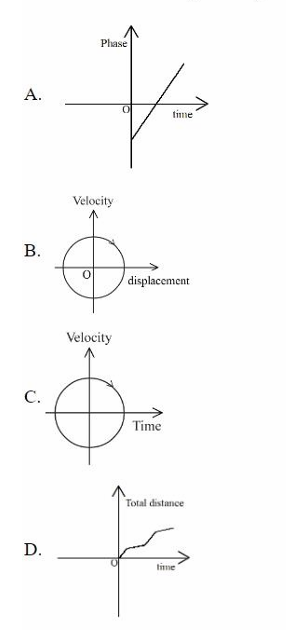
Which of the following curves possibly represent one-dimensional motion of a particle?
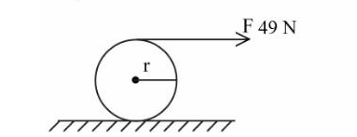
A force of 49 N acts tangentially at the highest point of a sphere (solid) of mass 20 kg, kept on a rough horizontal plane. If the sphere rolls without slipping, then the acceleration of the center of the sphere is
Consider a cylindrical tank completely filled with water of height $1.6 \ m$ and cross-sectional area $0.5 \ m^2$. There is a hole in its side at a height of $90 \ cm$ from the bottom. Assume the cross-sectional area of the hole to be negligibly small compared to the cross-sectional area of the water tank. If a load of $50 \ kg$ is applied on the upper surface of water in the tank, then at the moment the hole is opened, the velocity of water coming out is:
($g = 10 \ m/s^2$)
A 4.0 cm long straight wire carrying a current of 8A is placed perpendicular to a uniform magnetic field of strength 0.15 T. The magnetic force on the wire is __________ mN.
- The equation for real gas is given by $\left(P+\frac{a}{V^2}\right) (V-b)=RT$, where P,V,T and R are the pressure, volume, temperature and gas constant, respectively. The dimension of $ab^{-2}$ is equivalent to that of :
- Match List - I with List - II.Choose the correct answer from the options given below :
List - I List - II (A) Coefficient of viscosity (I) $[ML^0T^{-3}]$ (B) Intensity of wave (II) $[ML^{-2}T^{-2}]$ (C) Pressure gradient (III) $[M^{-1}LT^2]$ (D) Compressibility (IV) $[ML^{-1}T^{-1}]$
Important Questions from Mechanics
A person measures mass of 3 different particles as 435.42 g, 226.3 g and 0.125 g. According to the rules for arithmetic operations with significant figures, the addition of the masses of 3 particles will be.
Match the LIST-I with LIST-II
LIST-I LIST-II A. Gravitational constant I. $[LT^{-2}]$ B. Gravitational potential energy II. $[L^2T^{-2}]$ C. Gravitational potential III. $[ML^2T^{-2}]$ D. Acceleration due to gravity IV. $[M^{-1}L^3T^{-2}]$ Choose the correct answer from the options given below:
A particle is released from height S above the surface of the earth. At certain height its kinetic energy is three times its potential energy. The height from the surface of the earth and the speed of the particle at that instant are respectively.
The angle of projection of a particle is measured from the vertical axis as $\phi$ and the maximum height reached by the particle is $h_m$. Here $h_m$ as function of $\phi$ can be presented as
Which of the following curves possibly represent one-dimensional motion of a particle?


